

When a reactor shuts down, fission power falls rapidly, but the isotopic composition of the fuel continues to change. Products of earlier fissions remain in the core, and their decay influences its subsequent behaviour. Among these products, xenon-135 is particularly important to reactor operation.
Its effect may become more pronounced only several hours after shutdown. The ability to restart therefore also depends on how long the reactor had been operating and at what power level. In this specific sense, a reactor has a memory: its past operation is reflected in the inventories of isotopes remaining in the fuel.
Xenon as a neutron poison
Xenon-135 (Xe-135) is a fission product with a very large thermal neutron absorption cross section. By capturing neutrons, it reduces the number available to contribute to further fissions. It is therefore classified as a neutron poison, also known as a reactor poison. The term describes its effect on the neutron balance.
A small fraction of Xe-135 is produced directly by fission. Most is formed through the decay of iodine-135 (I-135), which has a half-life of approximately 6.6 hours. The accumulated iodine therefore remains a source of xenon production even after a substantial reduction in the fission rate.
Xe-135 is removed through two pathways. Radioactive decay produces caesium-135, with a Xe-135 half-life of approximately 9.1 hours. Neutron capture produces Xe-136, which has a much smaller absorption cross section. In reactor physics, the latter process is also called xenon burnout. It is a nuclear transformation whose rate depends on the neutron flux.
Why the concentration rises after shutdown
During sufficiently prolonged operation at constant power, the production and removal of Xe-135 approach equilibrium. Its concentration then remains approximately constant, even though individual nuclei are continuously being produced and removed.
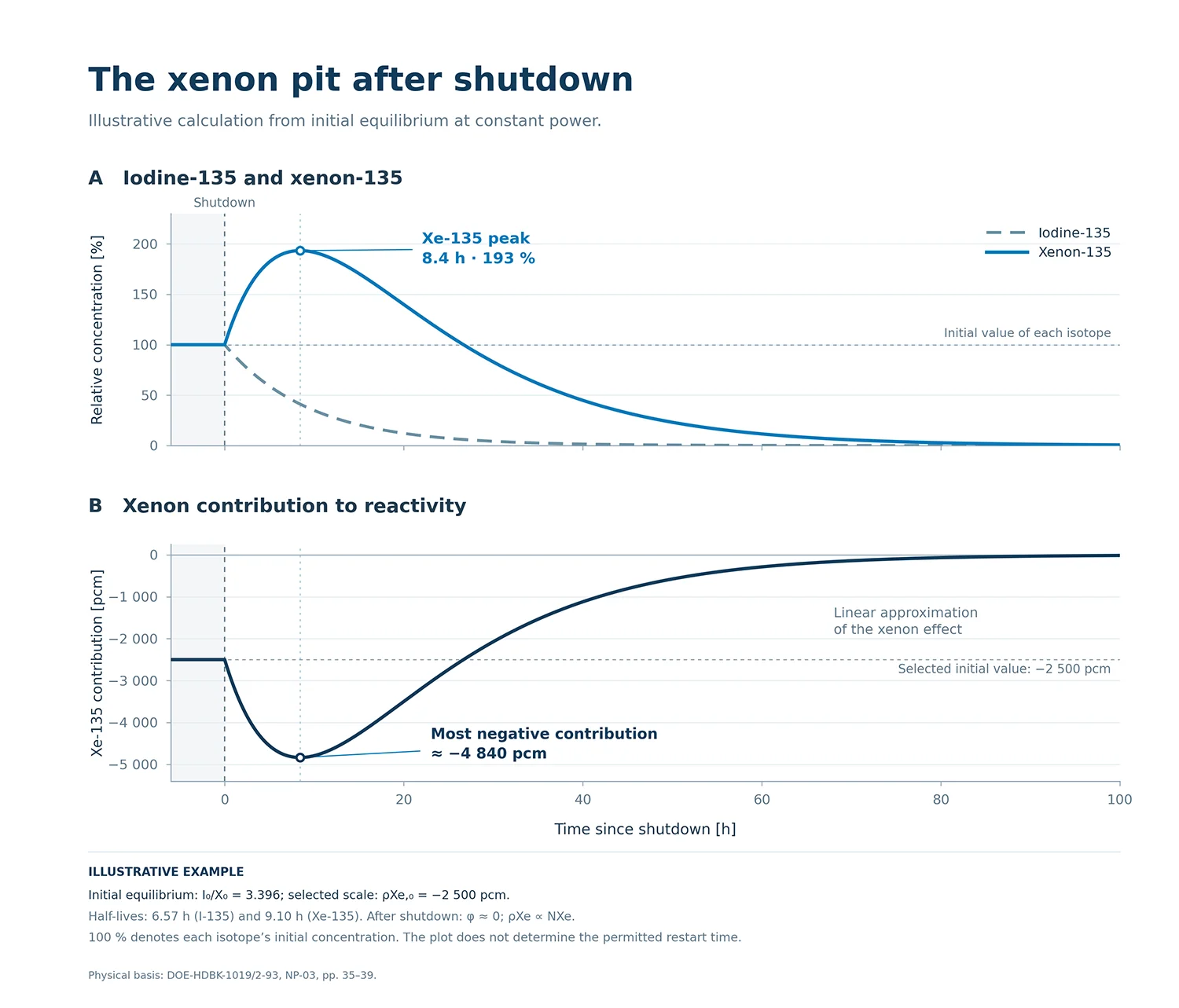
After shutdown from high power, the neutron flux falls sharply. Xenon removal by neutron capture consequently becomes negligible. The accumulated I-135, meanwhile, continues to decay into Xe-135. As long as this process produces xenon faster than xenon is removed by its own radioactive decay, the concentration rises.
The initial rise gradually comes to an end as the iodine inventory decreases. The xenon concentration peaks when its production and removal rates become equal. Removal then exceeds production, and the concentration starts to fall. Understanding the phenomenon therefore requires examining the balance between these two rates; comparing the half-lives of iodine and xenon alone is not sufficient.
In illustrative examples of shutdown from steady operation at high power, the peak often occurs approximately ten hours later. This is an indicative value. The actual timing and magnitude of the peak depend on the initial iodine and xenon inventories and the neutron flux before shutdown.
When the xenon pit prevents restart
As the Xe-135 concentration rises, its negative contribution to reactivity increases in magnitude. A plot of concentration shows a peak. A plot of the xenon contribution to reactivity shows a dip in the negative direction. This gives rise to the term xenon pit, also known as the iodine pit.
A xenon transient is the broader term for changes in xenon concentration and its effect over time. Restart is temporarily precluded only when the available positive reactivity is insufficient to compensate for xenon poisoning and achieve criticality. Criticality here means a self-sustaining nuclear chain reaction. This condition is termed xenon-precluded startup.
A xenon peak does not in itself mean that restart will be prevented. The available reactivity depends on the core design and condition. In a pressurised water reactor, for example, the ability to compensate for additional xenon changes as the fuel cycle progresses. The same elapsed time after shutdown therefore does not necessarily imply the same restart conditions at different stages of the cycle.
If xenon prevents criticality from being achieved, it is necessary to wait until its effect has diminished sufficiently through decay. The timing of peak xenon poisoning does not, by itself, determine when restart becomes possible again.
The assessment of whether startup is permitted also takes account of the applicable operating limits and the condition of the plant. A single generic curve cannot therefore establish a universal waiting period or determine when a particular plant is ready to restart.
Transients following power reductions and increases
Xenon transients also occur during changes in power while the reactor is operating. Following a power reduction from steady conditions, Xe-135 removal by neutron capture decreases immediately, while production from the iodine already present changes more slowly. The xenon concentration therefore initially rises.
Because the reactor remains in operation, some removal by neutron capture continues. For the same initial conditions, the peak following a partial power reduction is therefore generally lower than after a complete shutdown. With continued operation at the new constant power level, the iodine and xenon inventories gradually approach a new equilibrium.
When power is increased from a lower steady level, the initial response is usually reversed. The higher neutron flux accelerates Xe-135 removal, so its concentration initially falls and its negative reactivity effect weakens. Later, the contribution from the decay of newly produced iodine increases, and xenon begins to approach its new equilibrium value.
The xenon effect therefore continues to evolve after restart. Conditions at the point of reaching criticality can change considerably as power is raised. Subsequent reactor control depends on how rapidly xenon is being removed and how much iodine remains available to produce it.
The power distribution also matters
Iodine and xenon inventories are not necessarily distributed uniformly throughout the core. Because fission product generation and neutron capture depend on the local neutron flux, a change in operating conditions can produce a spatially non-uniform xenon response.
In some large thermal reactors, delayed xenon production can contribute to spatial power oscillations. In axial oscillations, the power distribution changes along the height of the core. Total power may remain approximately constant while the power split between the upper and lower parts of the core changes.
The shape of the power distribution and local power peaks therefore also matter in reactor operation. They affect the thermal loading of fuel rods and the available safety margins. Predicting the xenon response is linked to core monitoring and control actions that keep the power distribution within allowable limits.
Xenon decay changes reactivity again
As the Xe-135 concentration falls after the peak, neutron absorption in the core gradually decreases. With other conditions unchanged, this means that reactivity increases. This change matters even when no restart is planned: the continuing decay of xenon must be considered when maintaining a shutdown reactor in a subcritical state.
Planning power changes therefore requires anticipating how the transient will develop over several hours. The magnitude of the power change, the duration of operation at reduced power and the planned return to a higher power level must all be considered. In pressurised water reactors, control rods and soluble boron play a role, while the specific capabilities depend on the design and the stage of the fuel cycle.
Plants with suitable designs, supporting analyses and operating procedures can follow changes in load. Xenon transients are one of the factors that must be anticipated and managed during such operation. The allowable rate of power change and the ability to return to full power later are separate considerations.
The xenon pit illustrates why reactor operation also involves managing changes over time. Decisions about the next power change are influenced by processes initiated during earlier operation. Part of the operating team’s task is to understand how those processes are developing and anticipate the condition of the core several hours ahead.
The current power level tells us how much the reactor is producing. Its operating history helps explain how it will respond to the next change.
Image credits
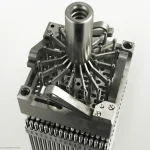
Cover photograph: The core of Krško Nuclear Power Plant during refuelling. Photo: Nuklearna elektrarna Krško, 22 April 2009, via Wikimedia Commons, licensed under CC BY-SA 4.0. The photograph has been cropped and visually adapted for use as the cover image.
The diagram “The xenon pit after shutdown” was created by Elite Studio 3D / By the Protocol specifically for this article as a simplified educational illustration of changes in iodine-135 and xenon-135 concentrations and the xenon contribution to reactivity following reactor shutdown. The values and time evolution shown are based on selected initial conditions and model assumptions. The diagram does not constitute design or operating documentation for any particular nuclear power plant and does not determine when reactor restart is permissible.
References
CANDU Fundamentals, Chapter 20, Xenon: A Fission Product Poison. Pages 205 to 210. Xe-135 production and removal, and half-lives. CANteach.
U.S. Department of Energy, Nuclear Physics and Reactor Theory, Volume 2. DOE-HDBK-1019/2-93, 1993. Module NP-03, Xenon, pages 35 to 42.
U.S. Nuclear Regulatory Commission, Westinghouse Technology 2.1 Reactor Physics Review. NRC training material, ADAMS ML11223A207. Xenon transients and restart conditions.
Canadian Nuclear Safety Commission, Science and Reactor Fundamentals: Reactor Physics. Technical Training Group, Revision 1, January 2003. Chapter 5, particularly power changes and restart. CANteach.
OECD Nuclear Energy Agency, Technical and Economic Aspects of Load Following with Nuclear Power Plants. June 2011. Sections 3.1 and 3.2. Physical constraints and methods of power adjustment.
IAEA, Non-baseload Operation in Nuclear Power Plants. Nuclear Energy Series NP-T-3.23, 2018. Sections 5.1.1 and 5.2.4, and Annex I. Control, power distribution and operating limits.
U.S. Nuclear Regulatory Commission, Issue 185: Control of Recriticality Following Small Break LOCA in PWRs. Used for the discussion of xenon behaviour over time, fuel-cycle effects and subcriticality after shutdown.
iodine-135 neutron poisons nuclear energy reactivity Reactor Physics reactor restart reactor shutdown xenon pit xenon transients xenon-135
Last modified: October 19, 2026