

In early 2025, after receiving several CGConnect recognitions between January and March, I started thinking about entering the CG Awards.
A friend suggested that I should create a cathedral. Something large. Something powerful. Something visually complex and impressive. So I did what I usually do at the beginning of a visual project: I started collecting references. Reference searching is never quick. You look for images for days. You compare angles, materials, structure, atmosphere, light, details and proportions. You try to understand what makes the subject visually and spatially strong. But while searching for cathedral references, another image kept appearing. It had nothing to do with cathedrals.
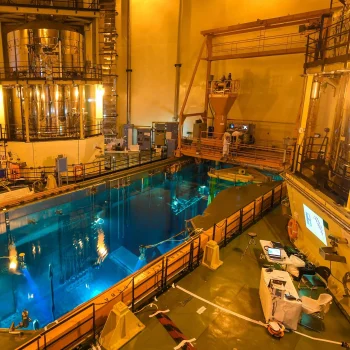
It was blue, luminous, technical and strange. There were people standing around it on what looked like a bridge. I kept seeing it again and again, day after day.
After a few days, curiosity won. I clicked. That click took me to the website of NEK, the Krško Nuclear Power Plant in Slovenia. At that moment, I did not really understand what I was looking at. I only knew that I could not stop looking. The image was full of details. A technical space, light, structure, metal, water, platforms, equipment, people and scale. My brain was flooded with visual information. I remember staring at it for about fifteen minutes, just trying to understand how things were arranged and what I was actually seeing.
It was not the blue glow alone that held my attention. It was the system around it. The geometry. The bridge. The hall. The relationships between objects. The technical order inside something I did not yet understand.

Source: Krško Nuclear Power Plant (NEK), public photo gallery.
And then a quiet question appeared:
Could I build this in 3D? That was the point of no return.
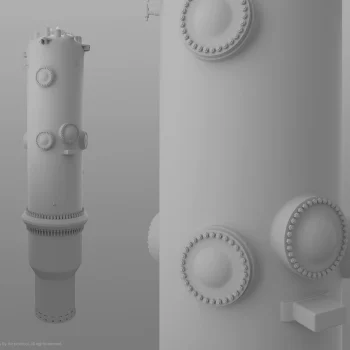
I started searching the NEK website. I collected every image of the reactor hall that I could find. I looked for views, fragments, angles, reflections, anything that could help me understand the space. Then I started modelling.
Very quickly, reality arrived. You do not simply find a reactor blueprint on the internet. I did not know the difference between fuel assemblies from different reactor designs. I did not understand enough about control rods. I did not yet know what belonged where, which part had a function, which detail was visible and which detail was only implied by the system.
One fuel assembly took me a month. Not because I was casually modelling it. Because it felt less like modelling an object and more like pushing my way through a system I did not yet fully understand. I was modelling, searching, comparing, correcting, starting again and sometimes quietly hoping for some kind of technical enlightenment because I knew I was looking at something important, but I did not yet have enough knowledge to fully understand it.
At some point, I had to admit something very simple: I could not continue like this. Either I would need a nuclear engineer next to me, or I would need to gain the knowledge myself. So I enrolled in the Nuclear Energy programme at TU Delft. Not because I had planned a career shift. Not because it was part of a long strategy. Not because I wanted a certificate for the sake of having one. I enrolled because the work required it.
Without nuclear knowledge, I could not model nuclear systems responsibly.
At first, I was afraid. I thought I was too old to start something so technical. I thought maybe I had missed the right moment. I thought the gap would be too large. But then something unexpected happened. I realised how much I liked it. The physics, the systems, the logic, the safety principles, the way one component affects another, the way a reactor is not just a machine but a structured network of decisions, constraints, feedbacks, procedures and responsibilities.
The more I learned, the more the original image changed in my mind. It was no longer only a beautiful blue light. It became a doorway. A doorway into reactor systems, fuel geometry, moderation, control, containment, cooling, storage and eventually into the broader question of how nuclear technology should be visualised and communicated.
I did not enter the CG Awards that year. I studied nuclear energy instead.
Later, the reactor core visualisation that grew from that first curiosity received CGConnect recognition in October. But the more important result was not the recognition. The important result was the change in how I work. Before that image, I was thinking about creating a powerful visual.
After that image, I began learning how to reconstruct technical systems with more discipline, more respect and more awareness of what I did not yet know.
That first Cherenkov light image did not lead me to a cathedral. It led me somewhere else. Into nuclear systems. Into documentation-driven reconstruction. Into the slow work of understanding before visualising.
And in the end, that became far more important than the project I had originally planned.
Note on Images and Materials
The photograph credited as Krško Nuclear Power Plant (NEK), public photo gallery is the property and/or copyrighted material of NEK and is used in this article with appropriate source attribution.
All other renders, diagrams, images, and 3D reconstructions published in this article are original visual works by Elite Studio 3D / By the Protocol, unless otherwise stated. They may not be copied, modified, redistributed, used commercially, or used as input material for AI-generated derivative works without prior written permission.
Cherenkov Light Documentation-Driven Reconstruction NEK Krško Nuclear Systems Technical Visualization TU Delft
Last modified: August 21, 2026