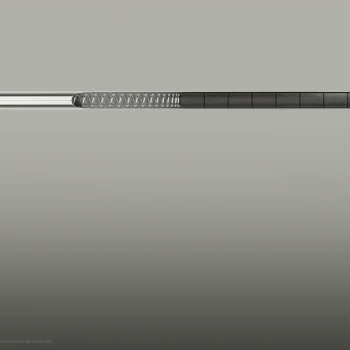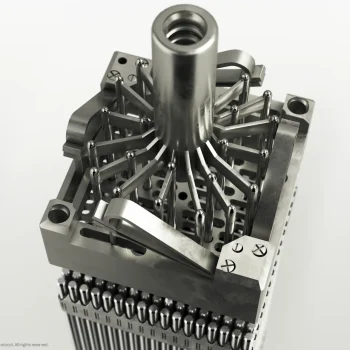


A fabricated fuel assembly enters the reactor with a defined isotopic composition, ceramic pellet microstructure and fuel rod geometry. Irradiation changes all three. Fission releases energy, neutron capture transforms nuclei, and the radioactive products of these reactions decay. Temperature and irradiation also change the dimensions, thermal properties and mechanical behaviour of the materials.
This article addresses conventional low-enriched uranium dioxide (UO₂) fuel for pressurised water reactors (PWRs) and boiling water reactors (BWRs). Assessing its use requires consideration of the energy produced, the evolving nuclide inventory and the loads on the fuel rod. The amount of uranium remaining is only one characteristic of the fuel.
Fission and heat generation
After absorbing a neutron, a U-235 nucleus may split into two lighter nuclei. Fission is accompanied by neutron emission and gamma radiation; the fission fragments carry most of the released energy as kinetic energy. They travel only a short distance through the fuel before stopping and depositing their energy. Heat then passes through the ceramic, the region between the pellet and the metal cladding, and the cladding itself into the coolant.
The chain reaction is sustained when a sufficient fraction of fission neutrons induces further fissions, while the remaining neutrons are absorbed without causing fission or leak out of the core. Water in a light water reactor slows neutrons down and also absorbs some of them. Changes in water density therefore directly affect the neutron balance, which is also governed by the fuel composition, core geometry, absorber materials and structural components.
U-238 predominates in fresh uranium fuel. U-235 accounts for a smaller fraction; it can undergo fission with thermal neutrons and is classified as a fissile nuclide. U-238 acts primarily as a fertile nuclide: neutron capture followed by radioactive decay produces fissile Pu-239. Some U-238 nevertheless undergoes direct fission with fast neutrons and contributes to the energy released. The terms fissile and fertile describe different nuclear properties.
How the isotopic composition changes
U-235 is consumed through two main pathways: fission and neutron capture without fission, which produces U-236. The decrease in the U-235 inventory thus includes nuclei that have not undergone fission. The resulting U-236 is not fissile with thermal neutrons; further captures involve it in the transmutation chains of heavy nuclides.
Pu-239 production begins with neutron capture in U-238. Two beta-minus decays follow, first from U-239 to Np-239 and then from Np-239 to Pu-239:
The notation (n, γ) denotes neutron capture accompanied by gamma emission. In β⁻ decay, a neutron in the nucleus converts into a proton, emitting an electron and an electron antineutrino. The mass number remains unchanged, while the atomic number increases by one. The sequence therefore proceeds from uranium through neptunium to plutonium.
Pu-239 can undergo fission during the same irradiation period. While some of the newly formed nuclei contribute to thermal power, others capture a neutron without fission and become Pu-240. A further neutron capture produces Pu-241, which is also fissile with thermal neutrons. The inventory of each isotope changes through production, fission, capture and decay. Some of the plutonium produced is consumed before the fuel leaves the core.
Irradiation also produces neptunium, americium and curium. In fuel cycle terminology, these are classified as minor actinides. Individual isotopes can make substantial contributions to decay heat or the neutron source term despite their small mass, so inventory calculations track nuclide quantities and their reaction and decay pathways. Simplified fuel cycle models follow selected actinides; more detailed inventory calculations also include fission and activation products.
Oxygen in the fuel material
In stoichiometric UO2, there are two oxygen atoms for every uranium atom. Oxygen atoms therefore outnumber uranium atoms, although uranium accounts for most of the mass of the fuel material. The initial isotopic composition of natural oxygen is dominated by stable O-16, with smaller fractions of O-17 and O-18. Their nuclear reaction rates depend on the number of target nuclei, the neutron flux and its energy spectrum, and the reaction cross sections.
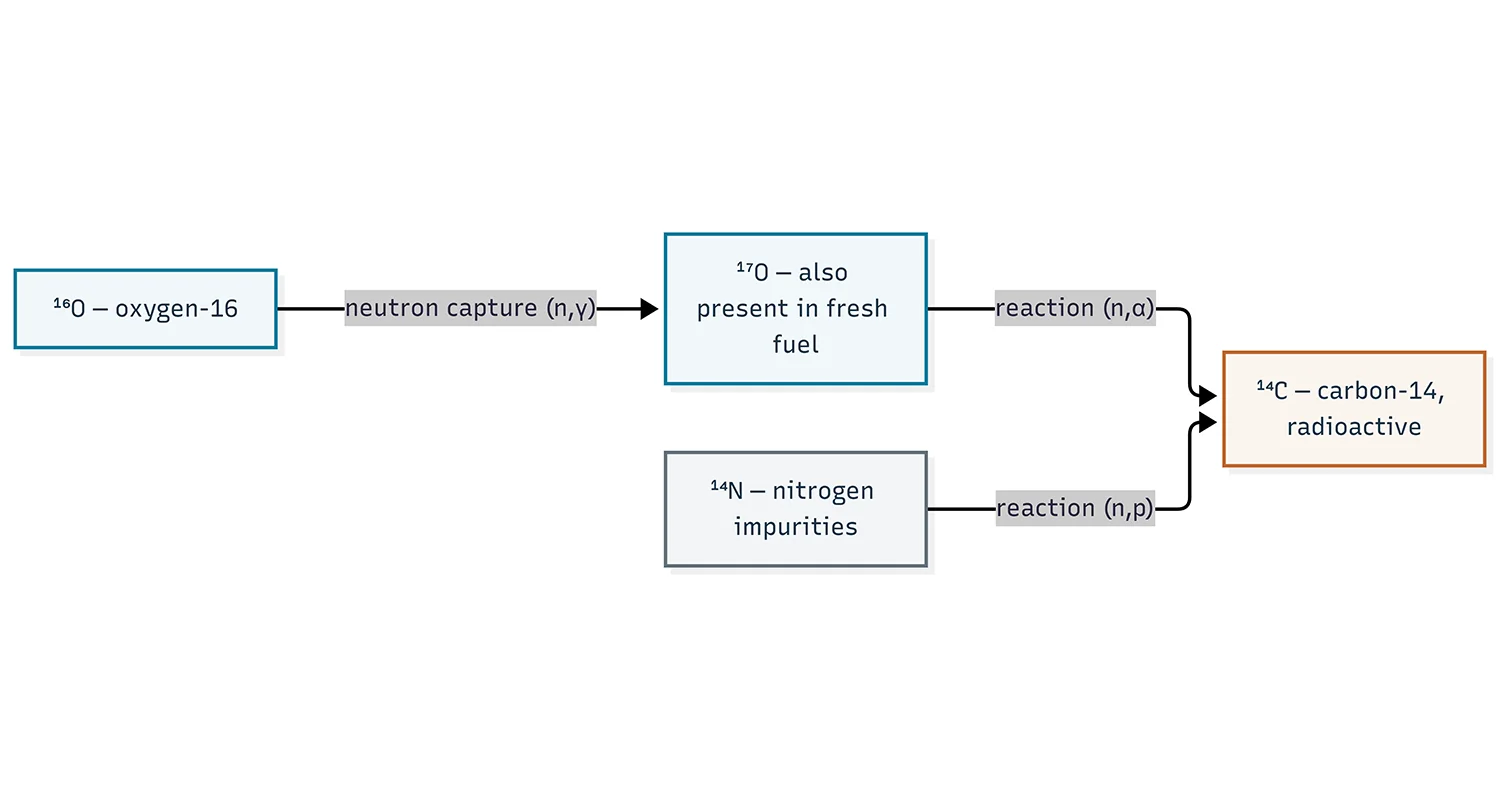
Neutron capture followed by gamma emission converts O-16 into O-17:
16O(n,γ)17O
The resulting O-17 is stable. In a further neutron-induced reaction, it can emit an alpha particle, a helium-4 nucleus, and become radioactive C-14:
17O(n,α)14C
O-17 is also present in fresh fuel. In the reference natural oxygen composition used here, it accounts for approximately 0.038% of oxygen atoms. Some C-14 is therefore produced directly from the initial O-17, while another contribution comes from O-17 produced by neutron capture in O-16 during irradiation. The first capture in O-16 does not itself produce C-14.
C-14 undergoes beta-minus decay to N-14, with a half-life of approximately 5,730 years. In the oxygen pathways considered here, it is an activation product of the fuel material. Nitrogen impurities can also contribute to its inventory through the reaction:
14N(n,p)14C
This reaction emits a proton. The nitrogen contribution depends on its initial abundance, the neutron spectrum and the irradiation history.
Simplified calculation
The graph compares C‑14 production from the initial O‑17 with the contribution from the sequential pathway 16O → 17O → 14C. The calculation considers 1,500 days of continuous irradiation at a constant monoenergetic neutron flux of 1014 n cm−2 s−1 and an energy of 0.0253 eV. The initial oxygen isotopic abundances are taken from NIST. The model includes O‑17 consumption through the (n,α) and (n,γ) reactions, as well as the radioactive decay of C‑14.
After 1,500 days, the normalised C-14 inventory from the initial O-17 is approximately 1.18 nuclei per million initial oxygen nuclei. The contribution via O-16 is approximately 0.0034 nuclei on the same basis, or about 0.29% of the sum of the two modelled pathways. The initial O-17 is available from the start of irradiation; in the second pathway, O-17 must first be produced by capture in O-16 and then react with another neutron. This sequence explains the slower initial increase and the curvature of the smaller contribution.
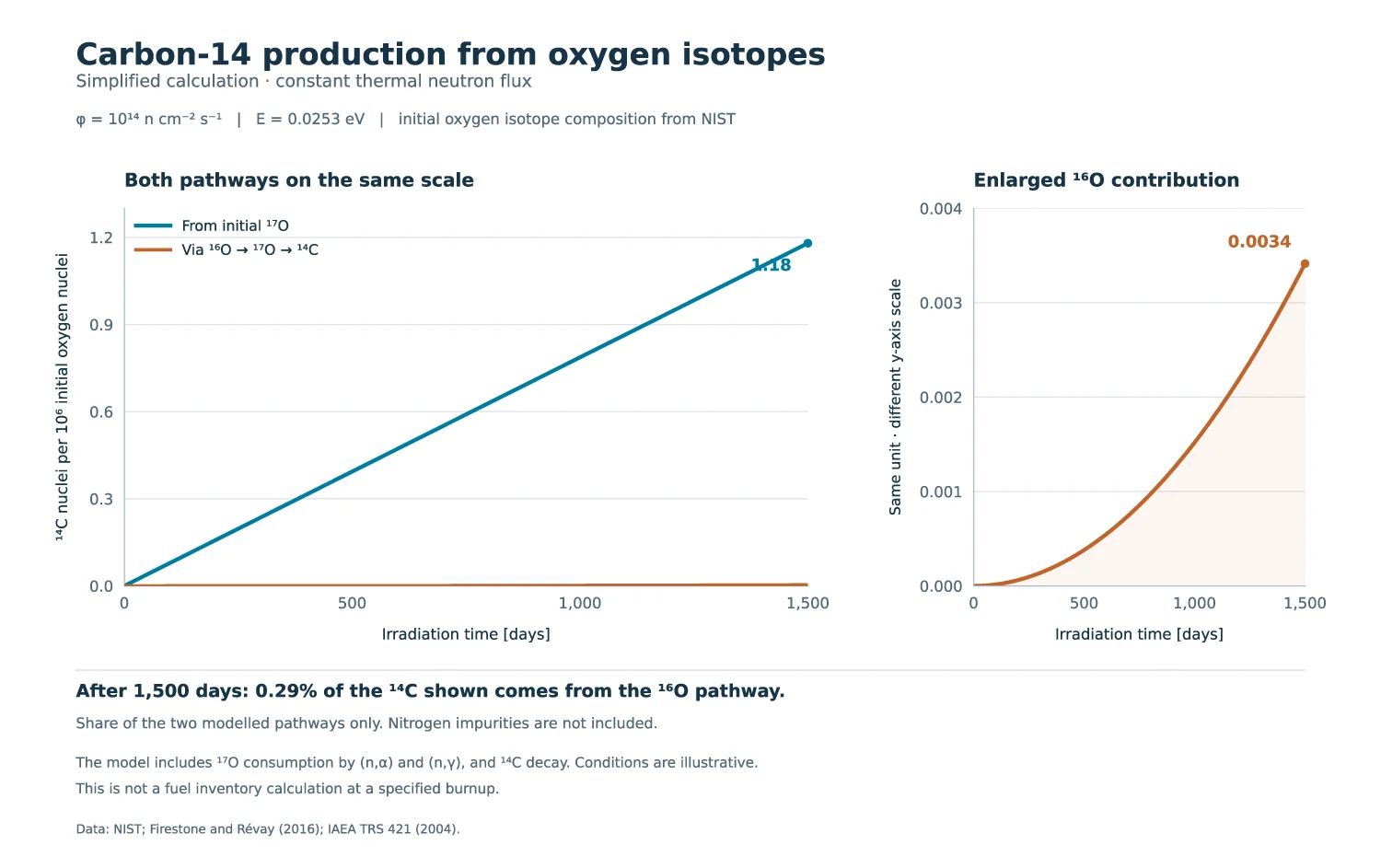
This is a simplified activation example for a prescribed neutron field. Nitrogen impurities and other C-14 production pathways are not included, nor is subsequent cooling. The result does not represent the inventory of a fuel assembly at a specified burnup. Such a calculation requires the material composition, the irradiation history and reaction data appropriate to the neutron spectrum in the fuel.
What burnup measures
Fuel burnup is the thermal energy produced per unit initial mass of heavy metal in the fuel. The term refers to nuclear transformations during irradiation, rather than chemical combustion:
Eth is the total thermal energy attributed to the fuel under consideration during irradiation, and mHM,0 is its initial heavy metal mass. For fresh uranium fuel, this is the initial mass of uranium. Oxygen in UO₂, the cladding and the structural components of the fuel assembly are excluded. The denominator remains tied to the initial loading even as the fuel composition changes in service.
Burnup is generally expressed in MWd/tHM or GWd/tHM; GWd/tU and GWd/MTU are also used for uranium fuel. HM denotes heavy metal, and MTU denotes a metric tonne of uranium. All these units refer to thermal energy. The electrical energy delivered to the grid also reflects the conversion efficiency and the plant’s own electricity consumption.
Worked example. Fuel with a burnup of 50 GWd/tHM has produced 50 gigawatt-days of heat per initial tonne of heavy metal. Converting each day to 24 hours gives:
The value of 50 GWd/tHM is used to illustrate the calculation; it is not a regulatory or design limit for the fuel.
Taking approximately 200 MeV as the energy recoverable as heat per fission, 1.2 TWh, or 4.32 × 10¹⁵ J, corresponds to approximately 1.35 × 10²⁶ fissions. A tonne of uranium contains approximately 2.53 × 10²⁷ nuclei if 238 g/mol is used as the mean molar mass. The ratio is about 0.053: at this burnup, the number of fissions is therefore equivalent to approximately 5% of the initial number of heavy nuclei. The estimate includes fissions of all contributing isotopes, including plutonium formed from uranium. A more precise calculation accounts for the actual isotopic mixture and the associated energy contributions. The remaining U-235 inventory is determined from its own production and depletion balance.
The same burnup can correspond to different nuclide inventories. Initial enrichment, neutron spectrum and irradiation history alter the balance between fission and capture, leaving different compositions even when the total energy produced is the same. Burnup summarises energy production; the inventory describes the resulting material composition.
Burnup distribution in the core
Local power determines how quickly burnup increases at a given location. The neutron field, isotopic composition, moderator density and absorber distribution create differences between fuel assemblies, between rods within an assembly and along the length of each rod. The radial distribution of fission and burnup within an individual pellet also changes.
A burnup value requires a spatial definition: an assembly average, a discharge batch average or a local value. A more heavily loaded section of a rod may reach a higher burnup than the assembly average. Fuel performance analyses relate these differences to the local linear heat generation rate and temperature history, since local conditions determine the loads on the ceramic and cladding.
Calendar time in the core does not determine burnup. During shutdown, radioactive decay changes the composition and releases decay heat, while the additional energy accumulated through fission is small compared with operation at power. Two assemblies with the same residence time can reach different burnups because of differences in power and irradiation duration.
Reactivity over the operating cycle
The effective multiplication factor keff characterises the multiplication of fission neutrons from one generation to the next in a given core configuration, accounting for absorption and leakage. It includes both prompt and delayed fission neutrons. Reactivity, ρ, expresses the departure from criticality:
At keff = 1 and ρ = 0, the configuration is critical. Under steady-state conditions, neutron production balances losses through absorption and leakage, and the neutron population remains constant. The fission rate determines the power level. A reactor can be critical at different power levels if its composition, temperatures, moderator density and absorber positions or concentrations provide the appropriate neutron balance. Zero reactivity does not indicate that the fuel is spent.
Delayed neutrons are emitted in the decay of precursors produced by fission. The precursor inventory reflects the preceding operating history. If reactivity returns to zero during a transient while the precursor inventory is still out of equilibrium with the current neutron flux, power may continue to change until precursor production and decay also reach equilibrium. For reactivity changes below the threshold of prompt criticality, precursor decay times have a substantial influence on the reactor’s time response.
Over the cycle, consumption of fissile isotopes and the accumulation of neutron-absorbing nuclides generally reduce the available reactivity. The production of fissile plutonium partly offsets this reduction. The core’s ability to sustain a chain reaction under specified reference conditions thus changes, while control actions and feedback effects keep the net reactivity close to zero during steady operation.
At the beginning of the cycle, burnable absorbers absorb a fraction of the neutrons, limit excess reactivity and help shape the power distribution. As they are depleted, their absorption generally decreases, adding positive reactivity. This contribution develops alongside fuel depletion and the production of new nuclides; in some designs, reactivity rises over part of the irradiation period. The absorber material, its distribution and the neutron spectrum determine its depletion rate, reaction products and any residual absorption.
Conventional PWRs compensate for long-term changes over the cycle by adjusting the concentration of dissolved boron in the primary coolant. Control rods also regulate reactivity and the power distribution. BWRs use control rods and burnable absorbers; changes in core flow allow power to be controlled through changes in steam void fraction and, consequently, neutron moderation. Dissolved boron is generally not used for routine reactivity control during BWR operation. Temperature and density feedback contribute to the response of both reactor types.
Fission products and neutron poisons
Fission produces lighter nuclei with a range of mass numbers. Many are neutron-rich and undergo decay chains towards more stable nuclides. Fission products include the direct products of fission and their decay descendants. Some are stable; others decay rapidly or remain radioactive long after irradiation.
A neutron poison is a nuclide whose absorption reduces the number of neutrons available to induce further fissions. The term describes its effect on the neutron balance. Radioactivity and neutron absorption are different properties; a strong absorber can also be stable.
Most Xe-135 is produced by the decay of I-135, with a smaller fraction produced directly by fission. During operation, it is removed by radioactive decay to Cs-135 and by neutron capture to form Xe-136. Following shutdown from a sufficiently high power level, the fall in neutron flux makes neutron capture almost negligible. The accumulated iodine continues to produce xenon, whose inventory rises as long as production from iodine exceeds removal by its own decay. A peak is followed by a decline. The additional absorption can temporarily prevent restart if its negative reactivity cannot be compensated. This is a transient effect in fuel that is otherwise still usable.
The time evolution of the xenon transient and its effect on restart are examined in more detail in The Xenon Pit: A Reactor Has a Memory.
Sm-149 is produced mainly by the decay of Pm-149, which is also formed from Nd-149 in the fission product decay chain. Sm-149 is stable. Its inventory continues to increase after shutdown as the remaining promethium decays, but it has no radioactive decay pathway of its own; during subsequent irradiation, neutron capture removes it by producing Sm-150. Alongside xenon and samarium, the combined absorption effect of other fission products also evolves throughout the cycle.
Changes in the ceramic and cladding
Temperature gradients within the pellet produce stresses and cracks in the ceramic. During early irradiation, densification through a reduction in porosity can decrease its volume, while the production and accumulation of solid and gaseous fission products cause fuel swelling. Relocation of cracked fragments changes the outer geometry of the pellet. Together with thermal expansion and changes in thermal conductivity, these processes alter the pellet–cladding gap and heat transfer to the coolant.
Thermal expansion and fuel swelling reduce the pellet–cladding gap, as does inward cladding creep when coolant pressure exceeds the internal rod pressure. Once the surfaces come into contact, further pellet expansion increases contact pressure and cladding stresses and strains. This is pellet–cladding mechanical interaction, or PCMI. A rapid power increase can intensify the loading: the pellet heats up and expands, while the time-dependent creep response of the cladding may be too slow to relax the resulting stresses.
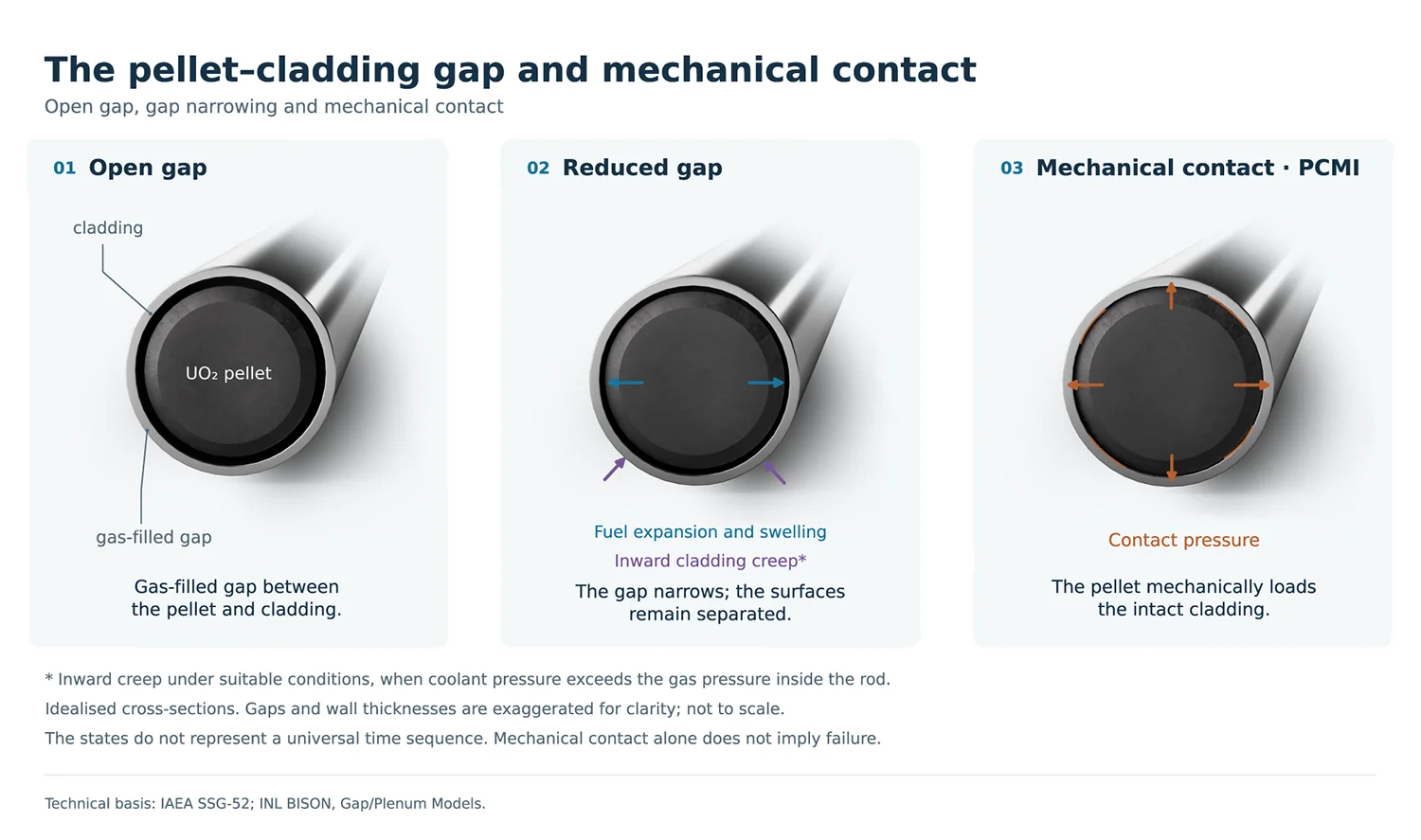
PCMI can occur in a leak-tight, serviceable rod; mechanical contact between pellet and cladding does not, by itself, constitute failure. Fuel rod design and limits on power changes must prevent failure due to excessive PCMI during normal operation and anticipated operational occurrences. In design basis accidents involving rapid power transients, however, excessive PCMI combined with reduced cladding ductility due to hydrogen uptake at high burnup can cause failure. The broader term pellet–cladding interaction (PCI) also encompasses chemical effects. In the fuel failure literature, it often denotes an interaction in which tensile stresses and corrosive fission products, such as iodine, cause stress corrosion cracking of the cladding. This mechanism requires mechanical loading, a suitable chemical environment and a susceptible material to be present together. Mechanical contact alone does not establish these conditions.
The fission gases xenon and krypton are partly retained in the ceramic and in bubbles, while some are released into the free volume of the rod. Their release changes the gas mixture, its effect on heat transfer across the gap and the internal pressure; gas temperature and available volume also affect the pressure. Release from the pellet into the interior of a leak-tight rod is part of fuel behaviour in service. Release into the coolant requires a leak path through the cladding or another part of the rod.
During operation, zirconium alloy cladding undergoes corrosion, hydrogen uptake, irradiation-induced microstructural changes and creep. Oxidation reduces the remaining metallic cross-section, while absorbed hydrogen can form hydrides and alter cladding ductility. Assessment of continued use therefore considers cladding condition, temperature history and actual loading, alongside burnup as a measure of the energy produced to date.
A cracked pellet can remain enclosed within a leak-tight fuel rod. Rod integrity is assessed from the condition of the metallic barrier and the conditions under which it must retain radioactive material. Allowable burnup is established through qualification of the fuel design, analyses and the permitted operating conditions for that fuel.
The relationship between cladding leakage, radionuclides in the coolant and fuel inspections is discussed in When a fuel rod develops a leak.
Why fuel is replaced
During a scheduled refuelling outage, only part of the fuel inventory is normally replaced. The other assemblies continue irradiation in the next cycle, often in new positions. The loading pattern combines reactivity and power distribution requirements with core shutdown capability, thermal limits and fuel condition.
Fuel is discharged as part of planned fuel management, before all fissile material has been consumed. The decision takes account of the reactivity available for the next planned cycle, material limits and the economics of continued operation. An assembly may still contain U-235 and the fissile plutonium isotopes, yet no longer meet the requirements of the next loading pattern or the allowable loads.
Irradiated fuel is fuel that has been exposed to neutron irradiation, including fuel temporarily removed to the pool during an outage and intended for reloading into the core. Spent fuel is irradiated fuel for which further use in its present form is not intended. The first term describes irradiation history; the second reflects the decision on further use.
What remains in the fuel
After conventional use of uranium fuel in a light water reactor, most of the fuel material mass, on a basis excluding oxygen and structural components, remains uranium, predominantly U-238. The fuel also contains residual U-235, U-236 formed during irradiation, plutonium, other actinides and fission products. The table groups selected nuclides by their origin and role after irradiation.
| Group | Example nuclides | Role after irradiation |
| Uranium | U-238, U-235, U-236 | The dominant remaining heavy material. U-235 remains fissile with thermal neutrons; U-238 acts primarily as a fertile nuclide. |
| Plutonium | Pu-239, Pu-240, Pu-241 | The isotopes have different nuclear properties. Pu-239 and Pu-241 are fissile with thermal neutrons; Pu-241 decays to Am-241 during cooling. |
| Minor actinides | Np-237, Am-241, Cm-244 | Contribute to the radiation characteristics of the remaining material; some also make substantial contributions to decay heat and the neutron source term. |
| Fission products | Cs-137, Sr-90, Nd-148 | Radioactive and stable nuclides with different absorption and radiation properties. Cs-137 and Sr-90 are radioactive; Nd-148 is stable. |
The table is qualitative. The examples do not represent the complete inventory or the mass fractions of a particular fuel assembly.
Mass fractions require a clearly defined basis of comparison. The uranium fraction in fuel material excluding oxygen differs from its fraction in the complete assembly, which includes oxygen, cladding and structural components. A specified composition also requires the initial enrichment, burnup, irradiation history and cooling time to be stated. These data allow inventories to be compared on a common basis.
An irradiated assembly also contains activation products in its cladding and other structural materials. These are formed by nuclear reactions in those materials and contribute to the radiation source term of the complete assembly. Their quantities are calculated from the initial composition of the metal components, including relevant impurities, and the irradiation history.
The remaining uranium and plutonium can serve as feedstocks for reuse after appropriate reprocessing and fabrication into new fuel. The predominant U-238 retains primarily a fertile role, and its further use for energy production depends on the reactor system and fuel cycle route. A large remaining uranium mass fraction therefore does not, by itself, quantify the energy that could be obtained by continuing to operate the same rod.
Decay heat after shutdown
After shutdown and establishment of subcriticality, fission power falls rapidly. Radioactive nuclides continue to decay and generate decay heat. In addition to this continuing energy source, the heat removal system must remove the heat already stored in the fuel, coolant and other heated components at shutdown. These are two distinct terms in the heat balance.
Within the fuel material, decay heat is generated by fission products, actinides and their decay descendants. Shortly after shutdown, short-lived fission products make a large contribution; as they decay, the relative contributions of the different groups change. Inventory calculations also account for activation products from non-actinide constituents and impurities in the fuel when these are included in the material being modelled. For the complete irradiated fuel assembly, decay heat from activated cladding and other structural components must be added. A decay heat calculation for the fuel material thus has a different material scope from one for the complete assembly.
Calculating thermal power after shutdown requires the quantity and initial composition of the material, its irradiation history and the cooling time. A percentage of the previous operating power, without these data, does not adequately specify decay heat.
Activity, measured in becquerels, counts radioactive decays per second. Decay heat power, measured in watts, also accounts for the decay energy available for deposition in matter; energy carried away by neutrinos and antineutrinos is essentially not deposited in the system. Determining where heat is actually deposited also requires consideration of radiation transport, particularly photon transport. Shielding calculations require a radiation source term: the types, emission rates and energy spectra of photons and particles, including neutrons in spent fuel. The same total activity can correspond to different heat outputs and shielding requirements. Mass fraction describes the quantitative composition of the material.
During cooling, some nuclides are depleted by decay while their descendants are produced. Pu-241 decays by β⁻ emission to Am-241, so the Am-241 inventory can continue to grow after discharge. Its contributions to activity and heat also change. The inventory used for storage or transport must be calculated for the relevant cooling time.
After final discharge, four safety functions remain: heat removal, radiation shielding, confinement of radioactive material and maintenance of subcriticality. The remaining fissile material requires a criticality safety assessment of the storage or transport configuration, considering composition, geometry, moderation and absorbers under the specified conditions. Burnup, operating history, cooling time and assembly condition become inputs to the selection and verification of subsequent fuel management arrangements.
Note on illustrations
The diagrams and 3D visualisations were prepared by Elite Studio 3D / By the Protocol using publicly available technical references.
The pellet–cladding cross-sections are idealised. Gaps and wall thicknesses are exaggerated for clarity, and the geometry is not to scale. The three configurations do not represent a universal time sequence or the measured condition of a specific irradiated fuel rod.
References
U.S. Department of Energy. Nuclear Physics and Reactor Theory, Volume 1 of 2. DOE-HDBK-1019/1-93, 1993. Fission, fertile nuclides and beta decay; NP-01, Energy Release from Fission, and NP-02, Reaction Rates.
International Atomic Energy Agency. Design of the Reactor Core for Nuclear Power Plants. IAEA Safety Standards Series No. SSG-52, 2019. In particular, paras 3.47, 3.59–3.63 and 3.68–3.70, and Annex I: the pellet–cladding gap, PCMI, stress corrosion cracking and fuel operating limits.
U.S. Nuclear Regulatory Commission. NRC Reactor Concepts (R-100) Training Course. 2017. Sections on criticality, neutron absorbers and the characteristics of PWRs and BWRs.
International Atomic Energy Agency. Nuclear Fuel Cycle Simulation System (NFCSS): NFCSS Reactor Model (CAIN). Online documentation, undated. A simplified model of selected actinides and its assumptions; it is not a basis for a complete fission product inventory or radiation source terms.
Del Cul, G. D., et al. Analysis of the Reuse of Uranium Recovered from the Reprocessing of Commercial LWR Spent Fuel. ORNL/TM-2007/207, January 2009. Remaining uranium, the significance of the mass basis and uranium properties relevant to potential reuse.
Oak Ridge National Laboratory. SCALE 6.3.4 Documentation. ORIGEN Module. Online documentation. Sections 5.1.3 and 5.1.5: nuclide generation and depletion, irradiation, decay, activation, and the physical units of inventories and radiation source terms. Related chapter: Method of Solution.
Hu, J., Gauld, I. C., Peterson, J. L., and Bowman, S. M. US Commercial Spent Nuclear Fuel Assembly Characteristics: 1968–2013. NUREG/CR-7227; ORNL/TM-2015/619, September 2016. Reference nuclide inventories, activity, decay heat and radiation source terms as functions of cooling time.
Oak Ridge National Laboratory. SCALE Training: SCALE Nuclide Inventory and Radiation Shielding for Spent Fuel Storage and Transportation. Training programme and materials, NRC Professional Development Center, Rockville, Maryland, 29 September–2 October 2025. The programme includes Overview of Depletion/Decay Sequences and Relevant Files and the use of ORIGEN and ORIGAMI to calculate nuclide inventories, decay heat and radiation source terms.
U.S. Nuclear Regulatory Commission. Backgrounder on High Burnup Spent Nuclear Fuel. Online material, July 2024. Burnup, cladding condition and spent fuel properties.
Wagner, J. C., and Parks, C. V. Parametric Study of the Effect of Burnable Poison Rods for PWR Burnup Credit. NUREG/CR-6761; ORNL/TM-2000/373, March 2002. Effects of absorbers and neutron spectrum on the isotopic composition and reactivity of irradiated fuel.
International Atomic Energy Agency. Core Management and Fuel Handling for Nuclear Power Plants. IAEA Safety Standards Series No. SSG-73, 2022. Core analysis, power and burnup distributions, and refuelling planning.
U.S. Department of Energy. Nuclear Physics and Reactor Theory, Volume 2 of 2. DOE-HDBK-1019/2-93, 1993. NP-03: Reactivity, Xenon, Samarium and Other Fission Product Poisons; NP-04: Reactor Kinetics in Reactor Operation.
U.S. Nuclear Regulatory Commission. Backgrounder on Radioactive Waste. Online material, January 2024. Fission products, transuranic elements, decay heat and the material remaining in spent fuel.
Idaho National Laboratory. BISON Theory Manual. Introduction. Online documentation. Fuel thermomechanics, densification, swelling, fission gases, heat transfer, mechanical contact and rod internal gas pressure. Related chapters: Ceramic Fuels and Gap Plenum Models.
International Atomic Energy Agency. Storage of Spent Nuclear Fuel. IAEA Safety Standards Series No. SSG-15 (Rev. 1), 2020. Definition of spent fuel, safety functions and data for assessment of the storage configuration.
Oak Ridge National Laboratory. SCALE 6.3.4 Documentation. POLARIS – 2D Light Water Reactor Lattice Physics Module. Online documentation. Sections 3.2.6.1 and 3.2.6.2: specific power per unit initial heavy metal mass and cumulative burnup.
National Institute of Standards and Technology. Atomic Weights and Isotopic Compositions for Oxygen. Online database. Initial atomic fractions of O-16, O-17 and O-18. NIST oxygen isotope data.
Firestone, R. B., and Révay, Zs. (2016). Thermal neutron capture cross sections for 16,17,18O and 2H. Physical Review C, 93, 044311. Thermal cross sections for O-16(n,γ) and O-17(n,γ). doi:10.1103/PhysRevC.93.044311.
International Atomic Energy Agency (2004). Management of Waste Containing Tritium and Carbon-14. Technical Reports Series No. 421. Vienna: IAEA. Section 2.1, p. 3, and Section 3.1.3, pp. 11–12: C-14 decay, reaction pathways and contributions from oxygen and nitrogen impurities. IAEA TRS 421.
Burnup BWR Decay Heat Fission products from ore to energy Fuel Cladding Fuel performance nuclear fuel nuclear fuel cycle Nuclide inventory PCMI PWR reactivity Spent Fuel
Last modified: November 19, 2026