

Why reducing nuclear plant output during a heatwave does not mean the reactor is overheating
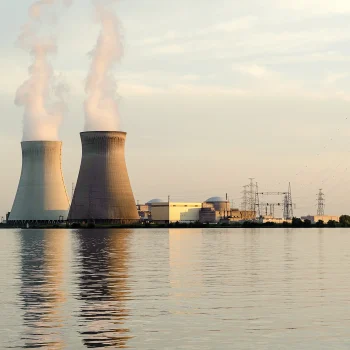
On 5 August 2026, Krško Nuclear Power Plant announced a planned and controlled temporary reduction in reactor power to 80% because of exceptional hydrological and meteorological conditions on the Sava River and to ensure compliance with environmental limits.
When we read that a nuclear power plant has reduced output or shut down a reactor during a heatwave, the headline can quickly create the wrong image: the plant has become too hot, and the reactor can no longer be cooled safely.
But in recent cases in France and Slovenia, the limitation arose somewhere else. It did not begin in the reactor core. It appeared at the end of the energy pathway — where the plant must reject the heat that was not converted into electrical energy.
To understand why a warm river can affect electricity production, we do not need to begin with nuclear physics. We need to begin with the energy balance.
The headline says that heat shut down the reactor
What it does not tell us is where it became too hot.
French utility EDF temporarily shut down three reactors because of high river temperatures and low flow rates, while reducing output at three others. The stated reason was compliance with environmental limits on additional river warming and the protection of aquatic ecosystems. This was not a report of failed reactor cooling or the loss of a safety function.
Krško Nuclear Power Plant similarly informed the relevant authorities that continued warming and very low flow of the Sava River could require a gradual reduction in reactor power and, under the most severe conditions, a controlled shutdown.
At the time of that announcement, the reactor was still operating at full power with the cooling-tower system in service.
The key term in both cases is not reactor overheating. The key term is heat rejection.
A power plant produces more than electricity
A nuclear reactor produces heat. Inside a pressurised water reactor plant, this heat is transferred through the steam generators and converts water in the secondary circuit into steam. The steam drives the turbine, and the turbine drives the electrical generator.
But not all thermal energy can be converted into electricity. Even a perfectly functioning power plant must reject a large part of its thermal input to the environment after the steam has passed through the turbine.
At the broadest level, the simplified energy balance can be written as:
The heat that was not converted into electrical work does not disappear.
After leaving the turbine, energy must be removed from the exhaust steam so that the steam can condense back into water and return to the process. That is the function of the condenser.
At Krško NPP, heat from the turbine exhaust steam is transferred through the condenser to the water of the tertiary cooling circuit. The purpose of this circuit is to remove heat that could not be converted into useful work and electrical energy.
This is how we arrive from the reactor to the river. Not because river water circulates through the reactor, but because the environment is the final recipient of the surplus heat from the thermodynamic process.
How much heat can water carry away?
The basic relationship can be expressed as:
where:
- is the heat-transfer rate, or thermal power,
- is the mass flow rate of water,
- is the specific heat capacity of water,
- is the change in water temperature.
The equation tells us something very simple.
The more water that flows through the system, the more heat it can carry away for the same temperature increase. When the flow rate decreases, the same amount of heat must be absorbed by a smaller mass of water. The resulting temperature increase is therefore greater.
The importance of flow can also be illustrated with a simplified calculation.
One cubic metre of water has a mass of approximately one thousand kilograms. If one cubic metre of water flows through a system every second and its temperature increases by one degree Celsius, it can absorb approximately:
This is an idealised illustration of the physical relationship, not a calculation of the actual operation of any particular power plant. It does, however, show why flow matters.
When river flow decreases, the amount of heat that can be rejected for the same permitted temperature rise also decreases. If the water is already warm before reaching the plant, the remaining margin for additional warming becomes smaller still.
The limitation may therefore not lie in the plant’s ability to produce heat. It may lie in the amount of heat that the plant is permitted to discharge to the environment under the prevailing conditions.
A river is not an infinite heat sink
Environmental requirements define how much plant operation may increase river temperature and what the maximum temperature may be after the discharged water has fully mixed with the river.
Krško NPP must ensure that:
- the average daily temperature of the Sava River at the defined point of complete mixing does not exceed 28 °C.
- the average daily temperature increase caused by plant operation does not exceed 3 °C.
This means that the plant cannot monitor only its internal temperatures, pressures and flow rates.
It must also monitor the condition of the wider system:
- river temperature,
- river flow,
- weather forecasts,
- the rate of further warming,
- expected hydrological conditions,
- the effect of the cooling towers,
- the permitted thermal load on the environment.
When the river approaches a prescribed limit, the plant does not wait for the limit to be exceeded.
It first uses the available systems to reduce the thermal load on the river.
During unfavourable hydrological and meteorological conditions, Krško NPP operates its cooling towers so that part of the heat is transferred to the atmosphere instead of directly to the Sava River. The system can adjust the combination of pumps, cooling-tower cells and fans according to current conditions.
If that is no longer sufficient, the next step is to reduce reactor power.
Lower reactor power means less heat entering the steam cycle, less steam flowing through the turbine and, consequently, less heat that must be transferred through the condenser to the cooling water.
A controlled shutdown may follow if conditions require it.
Warmer cooling water also reduces efficiency
The effect of a heatwave begins before an environmental limit is reached. Warmer cooling water creates less favourable conditions inside the condenser.
Steam can condense only at a temperature above that of the cooling medium. When the cooling-water temperature rises, the condensation temperature and condenser pressure also rise.
This results in a poorer condenser vacuum or, stated another way, higher backpressure at the turbine exhaust. The steam can therefore no longer expand through the turbine to as low a pressure as it could under cooler conditions. The available enthalpy drop becomes smaller, and the turbine produces slightly less mechanical work from the same steam flow.
Cooling towers also require pumps and fans. Their operation increases the plant’s internal electrical consumption.
The reactor can therefore remain at full thermal power while the plant delivers slightly less electrical power to the grid. Krško NPP described this effect during the June heatwave: operating the cooling towers increased internal electricity consumption, while warmer tertiary cooling water reduced the thermodynamic efficiency of the secondary circuit.
This is not a system failure. It is an expected consequence of thermodynamics.
A heat engine operates most effectively when the temperature difference between the heat source and the cold sink is large. When the cold sink becomes warmer, the available temperature difference decreases.
Reducing production is not the loss of safety cooling
This is where the most common misunderstanding appears.
From the statement:
The plant is reducing power because the river temperature is too high.
people may quickly reach the conclusion:
The reactor can no longer be cooled because of the heat.
These are not equivalent statements.
In the cases described here, the limitation concerns the amount of heat that a plant operating at high power may discharge into a river without exceeding environmental conditions.
That is not the same as:
- a loss of coolant,
- the loss of the ultimate heat sink,
- or the failure of a safety system.
A reactor does not stop producing heat at the exact moment it is shut down. The fission chain reaction is terminated, but the radioactive decay of fission products continues to generate decay heat. That heat must continue to be removed in a controlled manner.
However, the thermal power of a shut-down reactor is far lower than its thermal power during full operation, and it continues to decrease with time.
We must therefore distinguish between:
rejecting the large quantity of process heat produced during electricity generation
and
safety-related removal of decay heat following reactor shutdown.
Both involve heat and cooling. They do not have the same scale, purpose or operational context.
A safe shutdown can look like weakness in a headline
When a power plant reduces output in time to avoid exceeding the permitted thermal load on a river, it is operating within predetermined limits.
Public interpretation can reverse that meaning.
A controlled power adjustment becomes evidence of unreliability.
An orderly shutdown becomes evidence of danger.
Compliance with an environmental limit becomes an alleged inability to cool the reactor.
An action that demonstrates control can therefore be presented as a loss of control.
Part of the problem lies in language. The word cooling is used for several different systems and functions. Without further explanation, it may refer to:
- condensing turbine exhaust steam,
- cooling auxiliary components,
- removing decay heat,
- or maintaining the ultimate heat sink required by safety systems.
When all these meanings are compressed into a single headline, the public has little opportunity to see the difference. When reading about a reduction in nuclear plant output, it is therefore not enough to ask:
Does the plant need water for cooling?
Of course it does. More precise questions are:
- Which part of the system is being cooled?
- How much heat is being removed?
- Is this a production constraint, an environmental condition or a safety-system failure?
- Was the reactor shut down preventively and under control?
Only then does the headline acquire technical meaning.
Follow the energy
When a river is colder and its flow is higher, it can absorb more heat while undergoing a smaller temperature increase.
When the river is warmer and its flow is lower, the same energy balance can no longer be maintained under the same permitted conditions.
The plant must therefore adapt: first through the use of cooling towers, then by reducing output, and, if necessary, through a controlled shutdown.
Not because the plant cannot manage thermal-hydraulics. But because it must manage them precisely enough to know:
- how much heat it produces,
- how much of that heat becomes electrical energy,
- how much must be rejected,
- and how much may be discharged to the environment under the prevailing conditions.
The next time a headline says that heat has shut down a nuclear reactor, do not begin with an image of an overheating core. Begin at the condenser. Look at the flow rate. Look at the temperature difference.
And follow the heat.
Author’s note
This article is an educational explanation of the relationship between a power plant’s energy balance, cooling-water temperature, river flow and environmental limits.
The equations and calculations shown are deliberately simplified and are intended to illustrate basic physical relationships. They do not represent calculations of the actual thermal balance, operating parameters or permitted limits of Krško Nuclear Power Plant or any other power plant.
Decisions to reduce reactor power or shut down a plant are based on actual measurements, forecasts, operating procedures, environmental permits and assessments made by the operator and the relevant authorities.
Photograph: Krško Nuclear Power Plant, NEK.
Sources
- Krško Nuclear Power Plant — NEK Operation under Low Sava River Flow and Elevated River Temperatures, 3 August 2026.
- Krško Nuclear Power Plant — NEK to Reduce Reactor Power to Ensure Compliance with Environmental Limits, 5 August 2026.
- Krško Nuclear Power Plant — NEK Operated at Full Power During the June Heatwave While Complying with Environmental Limits, 3 July 2026.
- Krško Nuclear Power Plant — Tertiary Cooling Circuit.
- Krško Nuclear Power Plant — Cooling Towers.
- Krško Nuclear Power Plant — Secondary Circuit.
- Naš stik — France Shuts Down Three Nuclear Reactors Due to Heat, 5 August 2026.
condenser cooling towers Cooling Water energy balance environmental limits Heat Rejection Krško NPP nuclear power plant power reduction reactor cooling Sava River thermal hydraulics
Last modified: August 21, 2026