

During operation of a pressurized water reactor, rods cannot be removed from the core for direct verification of their leak tightness. Fuel monitoring therefore includes radionuclide analysis of primary coolant samples and monitoring of the relevant process streams. A change in the radionuclide pattern can provide an early indication that one or more rods have lost leak tightness.
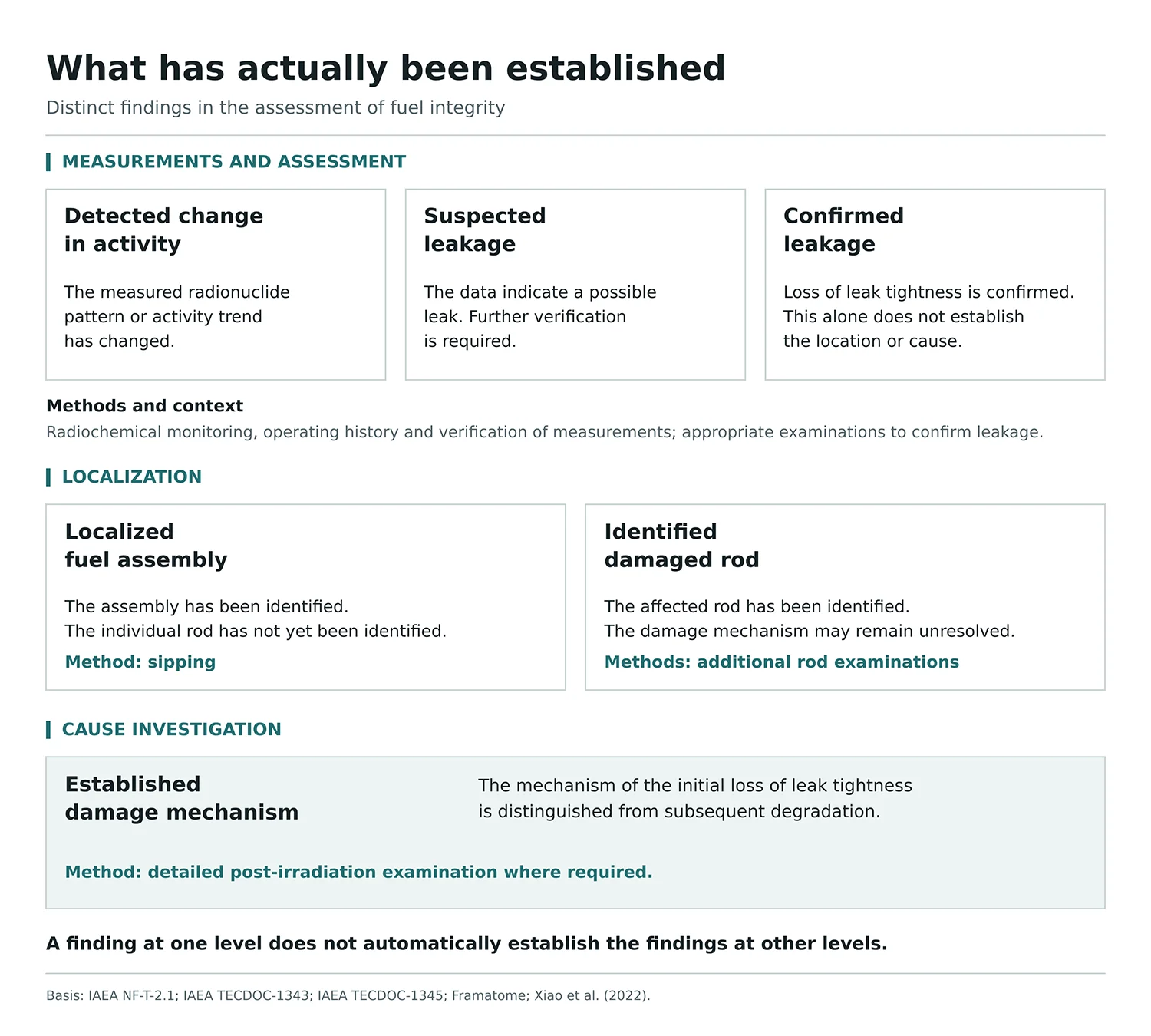
The investigation must establish whether the measurement indicates a new leak, whether the condition is progressing, which assembly contains the affected rod, and which mechanism caused the damage. These findings do not become available at the same time. Radiochemistry helps detect changes during operation; outage inspections enable localization and more detailed analysis.
Cladding between the fuel and the coolant
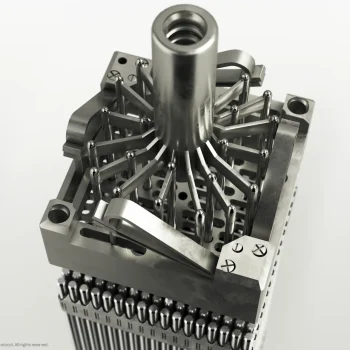
A metal tube with end plugs encloses a stack of ceramic fuel pellets, usually made of uranium dioxide, UO₂. In conventional light water reactor fuel, this tube, or cladding, is made of a zirconium alloy. Zircaloy denotes a particular family of these alloys. The designation does not encompass all fuel cladding materials. The ceramic matrix itself retains fission products. Sealed cladding retains those released from the pellets into the rod’s internal free volume during irradiation, while also separating the fuel material from the coolant. Both functions form part of the system of physical barriers and defense in depth.
Cladding integrity requires both leak tightness and retention of the required mechanical properties under the anticipated conditions. The absence of a visible crack does not fully establish integrity. Surface wear does not necessarily penetrate the wall; if damage does penetrate it, a pathway can form between the coolant and the rod interior. Local conditions, together with pressure and temperature differences, then influence water ingress and fission product release.
A leaking rod increases the potential for radioactive material to enter the primary system. Loss of leak tightness alone does not demonstrate failure of other barriers or a release to the environment. The extent of the damage, the plant condition and the performance of the remaining retention systems define the context in which the event must be assessed.
What we measure in the coolant
Total coolant radioactivity does not distinguish between leak-tight and leaking fuel. The primary coolant also contains radionuclides produced by activation: nitrogen-16 forms when neutrons react with oxygen in the water, and activated corrosion products may be present in the coolant and on surfaces. Radioactivity can therefore be detected even when the rods remain leak-tight.
Certain radioactive isotopes of xenon, krypton and iodine are particularly useful for monitoring fuel condition. By identifying the energies of the detected radiation, gamma spectrometry helps identify radionuclides and determine their activities. This enables a more detailed comparison with measurements from preceding days and with the background characteristic of the particular core. These radionuclides do not respond in the same way. For noble gases, transport from the fuel through the rod’s free volume and the leak path must be considered; for iodine, chemical form, dissolution and retention on surfaces also affect the result. A small leak therefore does not necessarily produce comparable increases in the activities of all monitored radionuclides.
Measurements must be assessed together with the sampling conditions. Sample representativeness, the interval between sampling and measurement, and retention of gaseous constituents influence interpretation of the result. For short-lived radionuclides, even a measurement delay can appreciably change the measured activity. Comparing successive results requires calibrated equipment and consistent application of the procedure.
Isotopic ratios require an operating context
Isotopes of the same element can have substantially different half-lives despite similar chemical behavior. The I-131 to I-133 activity ratio can therefore provide information about release from the fuel, but a single value cannot reliably distinguish every leaking rod from all other sources of activity.
One such source is tramp uranium: trace quantities of fuel material outside the sealed rods. It may originate from manufacturing residues or material dispersed during previous fuel damage. In a neutron field, this material can also generate fission products, which enter the coolant by pathways that differ from release from a leaking rod. Within a leaking rod, some radionuclides decay during transport through the fuel and the internal volume. This can alter the ratio of short-lived to long-lived isotopes. Elevated background activity from trace fuel material can mask the signal. Distinguishing the sources therefore involves combinations of isotopes, their time histories and appropriate release models.
Measured activities must be related to reactor power, recent power changes, and the operation of purification and degassing systems. More intensive radionuclide removal can change their concentrations even if the leak remains unchanged. Activity also does not directly determine the number of leaking rods: individual rods release different quantities of fission products, so the number of leaking rods inferred from activity remains a model-based estimate.
Why activity can increase during shutdown
Iodine spiking is a transient increase in iodine activity in the primary coolant that a change in power, temperature or pressure can trigger in fuel that is already leaking. The new conditions affect the release of iodine previously retained in the fuel or the rod interior. Such an increase does not require a new leak to develop.
A sustained increase in activity at steady power cannot be interpreted in the same way as an increase during shutdown. Chemists and the operating team must compare the measurement history with the sequence of operating events: when the activity changed, the shape of the increase, and how the values evolved afterward. The operating conditions preceding sampling form part of the interpretation.
How cladding loses leak tightness
The radiochemical response alone does not identify the damage mechanism. Common mechanisms, including fretting wear, pellet-cladding interaction, and corrosion and hydride-related processes, can produce similar radiochemical signatures. Manufacturing defects and handling damage are also possible. The prevalence of individual causes depends on the fuel type and operating environment.
Fretting wear caused by debris and grid contact
Debris fretting can develop when a small foreign object becomes trapped next to a fuel rod. Coolant flow excites its motion, and repeated contact with the cladding removes material locally, potentially causing wear through the full wall thickness. The object need not be large or visually conspicuous to cause this damage.
Grid-to-rod fretting occurs at the interface between the rod and the spacer grid. No foreign object is required. Wear results from vibration of the rod relative to its support; coolant flow, grid characteristics, and irradiation-induced changes in geometry and support forces affect the contact. The grid must provide adequate support throughout the intended service life of the fuel.
Identifying wall wear does not, by itself, determine the corrective action. For debris fretting, the source of the foreign object must be identified and further introduction prevented; for grid-to-rod fretting, the investigation also addresses rod support, vibration behavior and local hydraulic loads. Eliminating the cause therefore requires distinguishing between the two mechanisms.
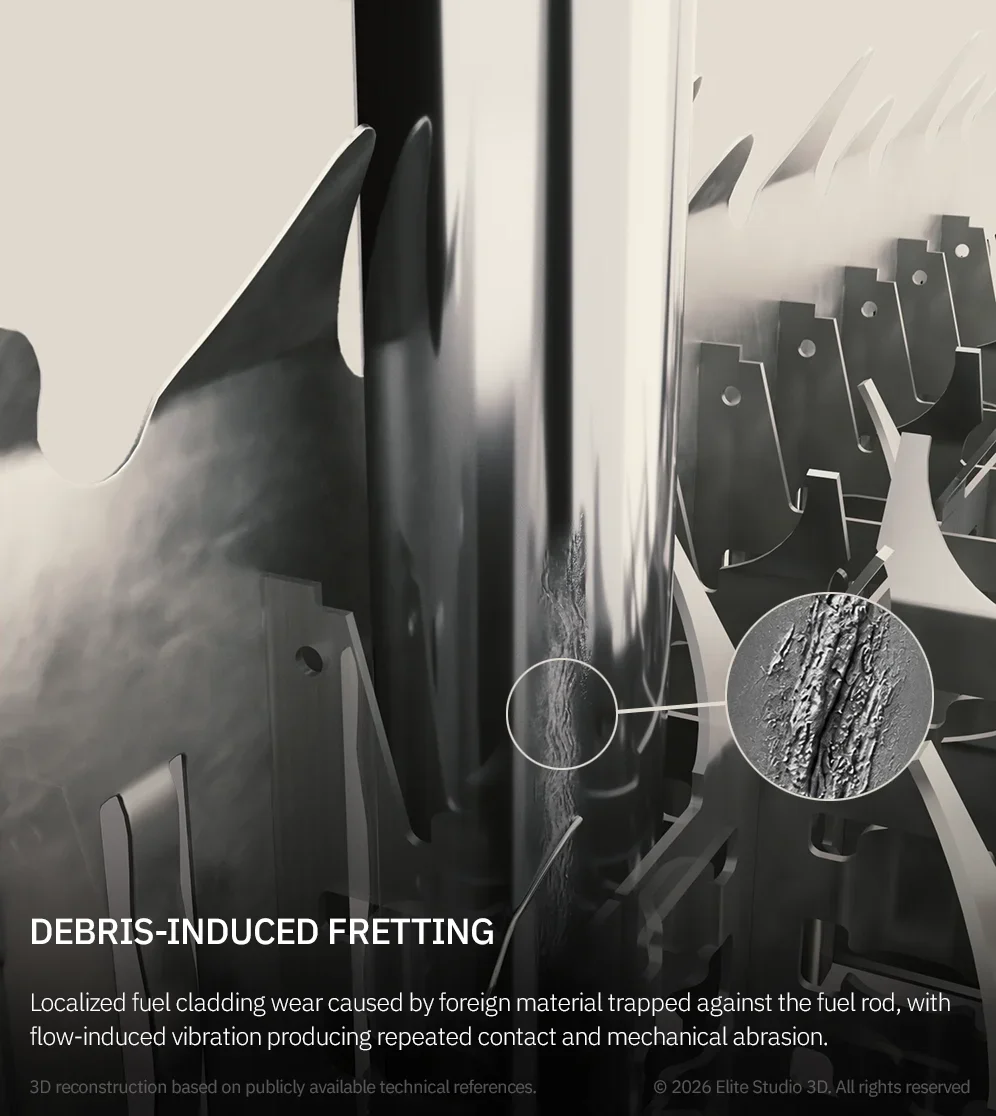
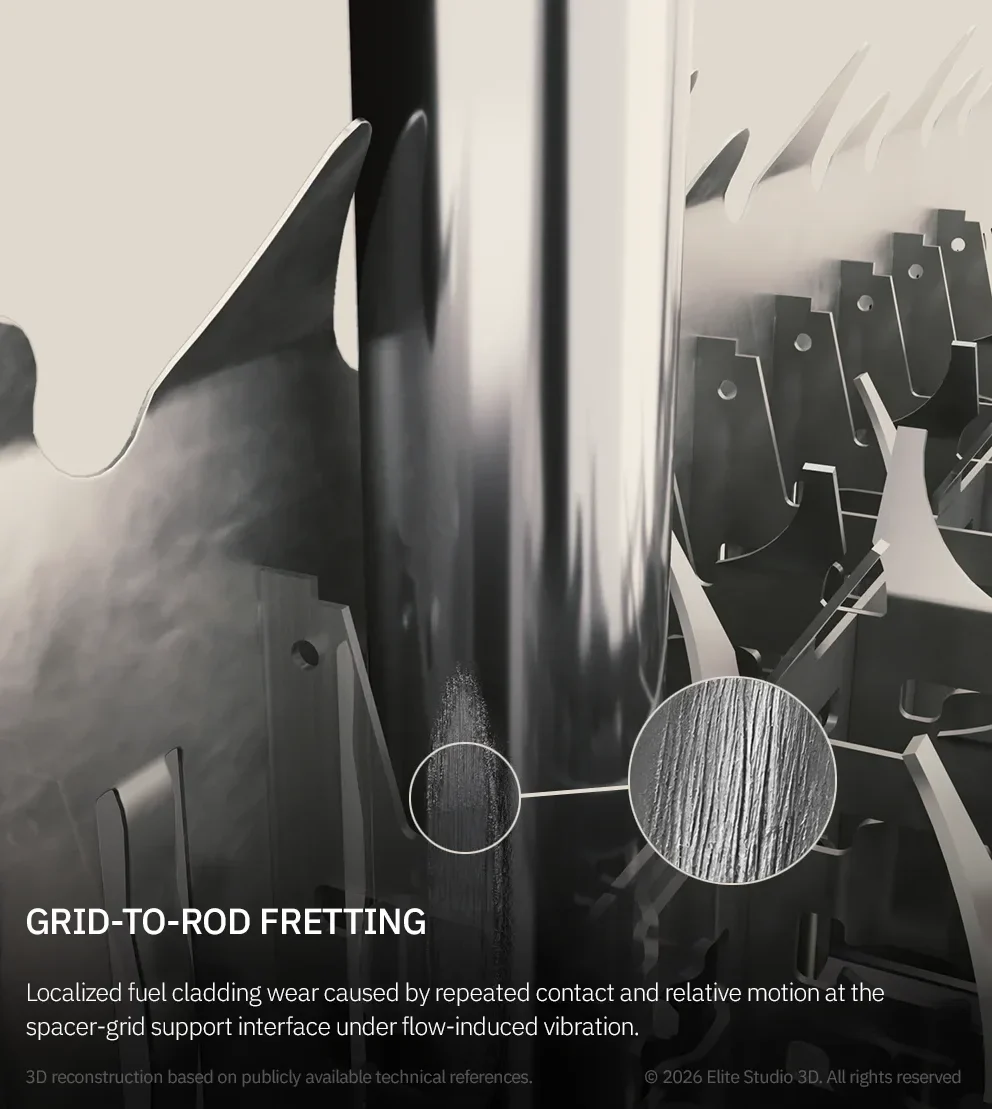
Comparison of debris fretting and grid-to-rod fretting. The 3D illustrations show localized cladding wear associated with contact with trapped foreign material and with the spacer-grid support, respectively. The enlarged details illustrate wear features; they are not inspection micrographs. Surface wear alone does not establish a through-wall breach.
Pellet-cladding interaction
Heating causes the fuel pellet to expand, while irradiation changes its structure, shape and contact with the cladding. Under these conditions, an increase in local power can raise mechanical stresses in the cladding. This mechanical interaction is termed pellet-cladding mechanical interaction, or PCMI. When tensile stresses coincide with a suitable corrosive environment on the inner cladding surface, stress corrosion cracking can develop. Fission products, particularly iodine, contribute to this form of damage, often designated PCI-SCC; the mechanism therefore requires mechanical and chemical effects to be considered together.
A power change does not, in itself, imply damage. The potential for damage depends on the fuel condition and loading history, local power, and the rate of change. Fuel design and appropriate restrictions on power changes reduce the likelihood of conditions developing that could cause cladding failure.
Corrosion and the effects of hydrogen
An oxide layer forms on the cladding surface as the zirconium alloy reacts with water during operation. Some of the hydrogen generated by this reaction can enter the metal and, under suitable conditions, precipitate as hydrides. Their effects on ductility and fracture toughness depend on their quantity, distribution and orientation, together with the cladding temperature and mechanical loading.
Corrosion, hydrogen uptake and loss of mechanical properties describe related but distinct processes. A visible oxide layer does not establish that the rod is leaking. The condition must be assessed against criteria applicable to the specific material and fuel. For a rod that is already leaking, the initial damage must be distinguished from subsequent degradation, which water inside the rod may influence.
Implications for operational assessment
Suspected leakage requires verification of the measurement and monitoring of its subsequent trend. Depending on the plant organization, chemistry, operations, fuel and core specialists, and radiation protection personnel contribute to the assessment. Joint evaluation of their information establishes the reliability of the diagnosis and its implications for subsequent work.
A confirmed small leak does not necessarily initiate an immediate automatic SCRAM. Operational limits and conditions, Technical Specifications and plant procedures determine whether continued operation is permissible, including allowable coolant activity, monitoring requirements and prescribed responses. All stipulated conditions must remain satisfied. If a deviation occurs, specified actions and completion times apply and may require shutdown.
Activity limits are also linked to the radiological assumptions used in safety analyses: an increased radionuclide inventory in the primary coolant can increase the quantity available for release during an analyzed event. Measurements therefore help assess fuel condition and verify the conditions underpinning the safety basis for operation. Coolant purification can reduce part of the system’s radiological burden. It does not restore the cladding’s leak tightness. Fuel with confirmed leakage requires monitoring for further degradation, while inspection and removal of the affected fuel must be incorporated into outage preparation, personnel protection and planned fuel handling.
Sipping links the signal to a specific assembly
Primary coolant activity does not usually reveal the direct location of a leaking rod in the core. Localization during an outage therefore begins by identifying the assembly that releases fission products. Sipping serves this purpose by analyzing water or collected gas obtained from testing an individual assembly.
An assembly can be tested in a dedicated container or with a measurement system integrated into the fuel handling equipment. A controlled change in temperature or pressure can promote release from leaking rods; in-mast sipping also exploits the decrease in external hydrostatic pressure as the assembly is raised from its position in the core. The collected sample is analyzed using an appropriate detector, and the result is compared with background. The time elapsed since shutdown and the implementation of the method affect both the choice of monitored radionuclides and test sensitivity.
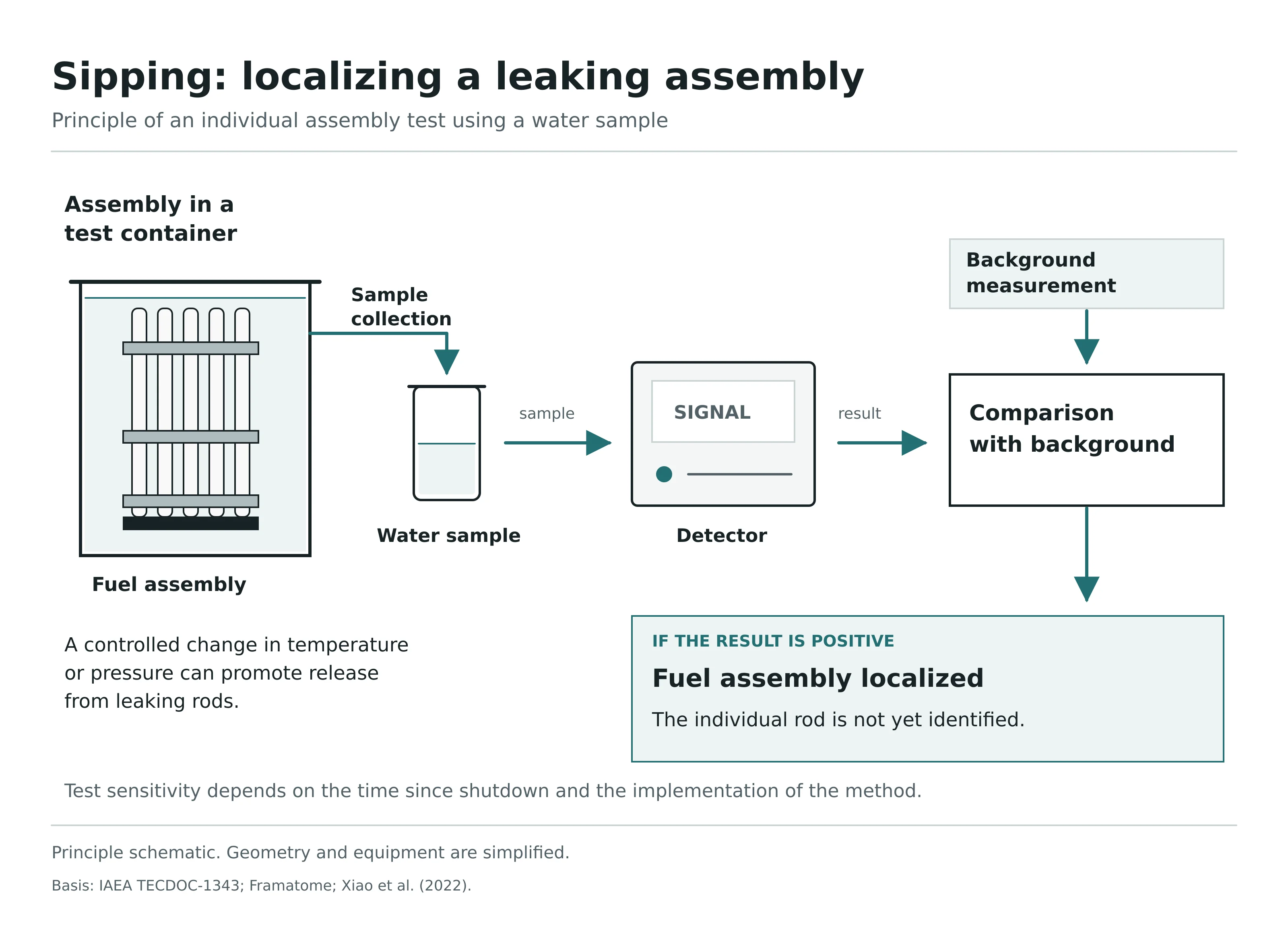
A positive sipping result can localize an assembly containing a leak. It does not, by itself, identify the affected rod or the axial location of the damage.
From a leaking assembly to the cause of damage
Identifying an individual rod may require additional examinations. Ultrasonic methods, for example, detect changes in ultrasonic wave behavior caused by water that has entered the rod, while visual inspections help identify foreign objects, deformation and accessible damage sites. The purpose of the investigation determines whether measurements of geometry or corrosion, or other fuel examinations, are needed.
The cause may remain unresolved after poolside inspections. A more detailed post-irradiation examination of the damage site, microstructure and fracture characteristics may then be required to establish which mechanism caused the initial loss of leak tightness and which changes resulted from subsequent degradation.
Assembly design and condition, together with the permitted procedures, limit the options for further use. Some assemblies allow reconstitution: affected rods are removed and replaced as appropriate. Others are withdrawn from further service. Any reloading requires prior inspections and evidence of an acceptable condition. The identified cause also determines the measures needed to prevent recurrence. For a foreign object, the investigation seeks to establish its entry path; inadequate rod support or a manufacturing deviation requires different corrective action. Fuel inspections, foreign material control and verification of repair effectiveness thus translate outage findings into measures to support reliability in the next operating cycle.
Fuel handling and the Palisades case
Mechanical damage to a fuel assembly and a confirmed fuel rod leak are different findings. Structural components and grids are parts of the assembly; damage to them may require special handling, while rod condition requires separate, appropriate examinations.
On October 21, 2026, Holtec reported the removal of a tilted fuel assembly from the reactor vessel at Palisades. Purpose-built equipment was used for the removal, and the assembly was transferred to the spent fuel pool in a special container. The announcement describes a demanding fuel handling operation. The description of that operation alone does not establish a cladding leak detected by radiochemistry during operation. Classifying fuel as damaged therefore requires information on the affected component, how its condition was established, and the functions affected. These details allow the event to be linked to an appropriate examination or action.
What a small leak tells us
A change in primary coolant activity does not, by itself, establish the location or mechanism of fuel damage. Operating decisions depend on verified measurements and applicable limits; assembly localization, rod identification and determination of the damage mechanism require their own supporting evidence.
Note on illustrations
The diagrams and 3D reconstructions were prepared by Elite Studio 3D / By the Protocol using publicly available technical references. Geometry and wear features are simplified for explanatory purposes. The illustrations do not document an inspected fuel rod or a specific fuel failure event.
References
IAEA. Chemistry Programme for Water Cooled Nuclear Power Plants. SSG-13 (Rev. 1), 2024. In particular, Chapters 6 to 8.
IAEA. Review of Fuel Failures in Water Cooled Reactors. NF-T-2.1, 2010. In particular, Chapter 4 on detection and examination.
ENUSA. Nuclear. Description of fuel rod manufacturing, quality control, fuel inspections and fuel services.
IAEA. Design of the Reactor Core for Nuclear Power Plants. SSG-52, 2019. In particular, the sections on barriers, thermomechanical design and pellet-cladding interaction.
ENSI. The nuclear fuel matrix. Series of articles on barriers, November 7, 2018.
Xiao, X., et al. Study on In-Service Inspection of Nuclear Fuel Assembly Failure Using Ultrasonic Plate Wave. Sensors 22, 7606, 2022.
U.S. NRC. Reactor Concepts R-100 Training Course. Explanation of sources of radioactivity and activation products.
IAEA. Spent Fuel Performance Assessment and Research. IAEA-TECDOC-1343, 2003. Sections on leak monitoring and sipping methods.
U.S. NRC. Resolution of Generic Safety Issues, Issue 197, Iodine Spiking Phenomena.
Lewis, B. J., et al. Iodine spiking model for pressurized water reactors. Journal of Nuclear Materials 244, 153–167, 1997.
IAEA. Review of Fuel Failures in Water Cooled Reactors 2006–2015. NF-T-2.5, 2019.
IAEA. Structural Behaviour of Fuel Assemblies in Light Water Reactors. IAEA-TECDOC-2106, 2025. In particular, the sections on vibration and wear at supports.
IAEA. Progress on Pellet–Cladding Interaction and Stress Corrosion Cracking. IAEA-TECDOC-1960, 2021.
Motta, A. T., et al. Hydrogen in zirconium alloys: A review. Journal of Nuclear Materials 518, 440–460, 2019. DOI 10.1016/j.jnucmat.2019.02.042.
IAEA. Fuel Failure in Water Reactors: Causes and Mitigation. IAEA-TECDOC-1345, 2003. Contributions on damage mechanisms and secondary degradation.
U.S. NRC. Standard Technical Specifications for Westinghouse Plants. NUREG-1431. Bases for limits on primary coolant specific activity.
Framatome. Fuel Leaker Detection and Localization Solutions. Description of sipping methods and ultrasonic localization.
Westinghouse. Reactor Services. Fuel inspections, post-irradiation examinations and assembly reconstitution.
Westinghouse. BlueRad 5-Sided Fuel Inspection Service. Inspections for foreign objects and damage before potential assembly reuse.
Holtec International. Holtec’s Engineering and Manufacturing Prowess Delivers Breakthrough Fuel Assembly Recovery at Palisades. October 21, 2026.
debris fretting Fuel Cladding fuel failure fuel inspection fuel integrity grid-to-rod fretting iodine spiking post-irradiation examination primary coolant PWR radiochemistry sipping
Last modified: November 4, 2026