
Dry Storage of Spent Nuclear Fuel
Dry storage of spent nuclear fuel is not an improvisation, but a purpose-designed passive safety system. This article explains how confinement, shielding, subcriticality and decay heat removal are maintained through geometry, materials and physical principles.


When Safety Relies on Physics, Not on Continuous Active Intervention
The management of spent nuclear fuel is among the most conservatively designed and tightly regulated fields in nuclear technology.
The reason is straightforward: after removal from the reactor, spent nuclear fuel remains a source of decay heat and ionizing radiation. It must therefore be managed in a way that protects people and the environment over long periods of time, far beyond the operational lifetime of many industrial systems.
Dry storage is not an improvised workaround. It is a purpose-designed engineered storage solution, widely used as a long-term interim stage before final disposal, reprocessing, or another national fuel cycle decision. Its primary objective is to keep spent fuel in a stable, controlled and predictable condition by maintaining four essential safety functions:
- confinement of radioactive material,
- radiation shielding,
- removal of decay heat,
- maintenance of subcriticality.
The strength of dry storage lies in the fact that these functions are not based on rapid response or continuous active intervention. They are based on geometry, materials, heat transfer and conservative engineering margins.
Thermal and Radiological Context of Spent Fuel
When fuel is discharged from the reactor, it does not stop generating heat.
The fission chain reaction has ended, but radioactive decay continues. Fission products and actinides inside the spent fuel continue to release decay heat and ionizing radiation. This heat decreases significantly with time, especially in the early period after discharge, but it remains an important design consideration throughout storage.
For this reason, the first stage of spent fuel management takes place in the spent fuel pool. Water provides three essential functions at once:
- efficient heat removal,
- radiation shielding,
- a controlled environment for fuel handling.
Only after a required cooling period in the spent fuel pool can spent fuel be transferred to dry storage. The required time depends on several factors, including fuel design, burnup, decay heat, storage system design and licensing requirements. In practice, this cooling period is often several years.
The purpose of this initial pool storage period is not simply to “wait”. It is to allow the thermal and radiological characteristics of the fuel to decrease to levels compatible with dry storage system limits.
Fundamental Architecture of Dry Storage Systems
Dry storage systems are based on a multilayered architecture. No single component carries the entire safety function by itself. Safety is achieved through the interaction of several engineered barriers and physical mechanisms.
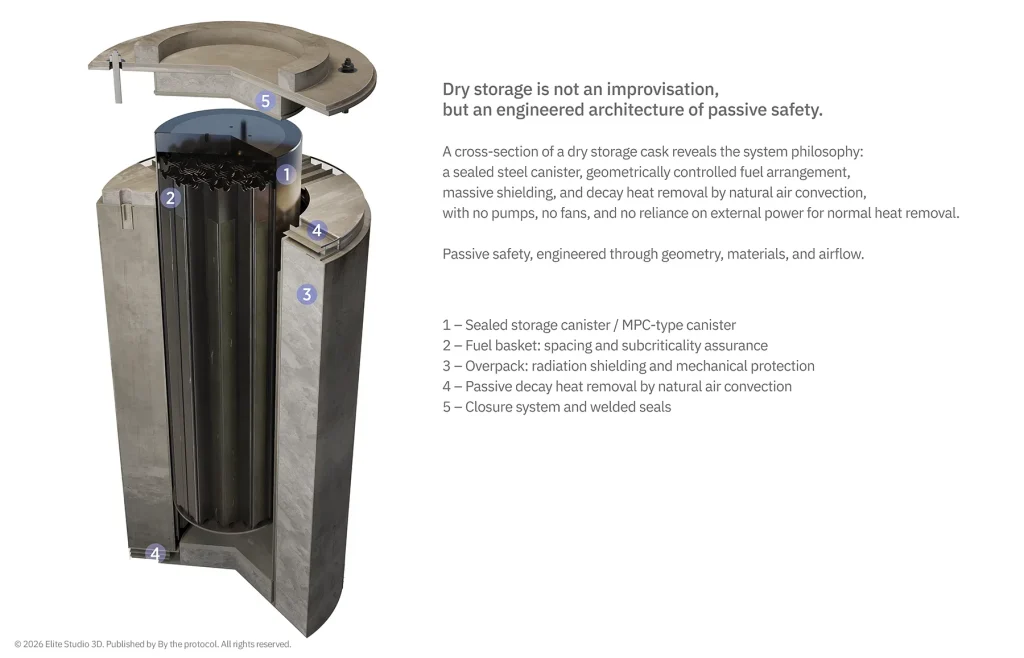
Although designs vary between vendors and countries, many canister-based dry storage systems include the following main elements:
- a sealed storage canister,
- a fuel basket,
- an external overpack,
- shielding structures,
- passive heat removal pathways,
- inspection and monitoring provisions.
Together, these elements form a system whose purpose is not to make spent fuel disappear, but to keep it stable, shielded, confined, cooled and traceable.
The Storage Canister
In canister-based systems, the inner storage canister forms the primary confinement boundary for spent fuel during dry storage. In some systems, this component is referred to as a Multipurpose Canister, or MPC. The term is commonly associated with certain dry storage system designs, but the general function is the same: to provide a sealed steel vessel for the long-term storage of spent fuel assemblies.
The storage canister has several key functions:
- confinement of radioactive material,
- mechanical protection and stabilization of the fuel assemblies,
- maintenance of a controlled internal environment,
- support for decay heat transfer.
After loading, the canister is drained, dried, backfilled with an inert gas, commonly helium, and sealed. Helium supports heat transfer and helps maintain an inert internal environment. The canister closure is then verified according to applicable technical and regulatory requirements. This may include leak testing, weld verification and other quality assurance steps.
Once sealed, the canister is not intended for routine access during storage. It functions as a passive confinement component within the larger storage system.
The Fuel Basket
Inside the canister, the fuel basket plays a critical role. It defines the geometric arrangement of spent fuel assemblies and maintains the required spacing between them. This geometry is essential for mechanical stability, heat transfer and criticality safety.
The fuel basket may include neutron-absorbing materials, depending on the design. These materials, together with the spacing and arrangement of the fuel assemblies, help ensure that the system remains subcritical under analyzed normal, off-normal and accident conditions defined in the safety case.
This is an important distinction.
Criticality safety in dry storage is not maintained by operator action or active control. It is maintained through design: geometry, materials, spacing, fuel loading limits and verified analysis.
The fuel basket is therefore not just an internal support structure. It is part of the safety logic of the entire system.
The Overpack
The overpack is the massive external structure that surrounds and protects the sealed canister.
Depending on the design, it may be made of steel, reinforced concrete, or a combination of both. Its functions typically include:
- radiation shielding,
- mechanical protection,
- support and positioning of the canister,
- guidance of airflow for passive heat removal,
- protection against defined external hazards.
From the outside, an overpack may appear simple: a large concrete or steel cylinder. In reality, its geometry is carefully shaped by shielding requirements, thermal limits, structural loads, airflow paths and regulatory acceptance criteria.
In ventilated vertical systems, the overpack includes air inlet and outlet paths. These allow ambient air to enter, heat up as it passes along the canister or internal structures, and exit through the upper vents.
This is not decorative geometry. It is the visible form of passive heat removal.
Passive Cooling as a Foundation of Safety
A defining feature of many dry cask storage systems is that decay heat removal is achieved passively during normal storage conditions. This means that heat removal does not rely on pumps, fans or external electrical power.
Heat is transferred from the spent fuel through the canister and surrounding structures by a combination of:
- conduction,
- radiation,
- natural convection.
In ventilated overpack systems, natural airflow removes heat from the storage system to the surrounding environment. Warm air rises through designed flow paths, while cooler air enters through lower openings.
The driving forces are basic physical principles: temperature difference, density difference, gravity and geometry. This is why passive heat removal is so important in dry storage. Loss of electrical power does not remove the normal heat removal pathway of these systems.
However, passive does not mean ignored.
Ventilation paths, temperatures, radiological conditions and the general condition of the storage installation remain part of inspection, monitoring and operational oversight. The safety advantage is not the absence of responsibility. The safety advantage is that the basic heat removal function does not depend on continuous active intervention.
Defence in Depth and Passive Stability
Dry storage systems reflect the nuclear principle of defence in depth.
Essential safety functions are provided through multiple, complementary features:
- the fuel matrix retains most radioactive material within the fuel itself,
- the cladding provides an additional barrier,
- the sealed canister provides confinement,
- the overpack provides shielding and mechanical protection,
- passive heat transfer removes decay heat,
- monitoring and inspection confirm that the system remains within expected conditions.
This layered approach is important because nuclear safety does not rely on a single perfect component. It relies on conservative design, verified barriers, analysis, quality assurance and continued oversight. In the context of dry storage, the safety philosophy is best described as passive stability.
The system is designed so that essential safety functions are maintained by materials, geometry and heat transfer mechanisms rather than by continuous operation of active systems.
That is the quiet strength of dry storage.
It is not dramatic.
It is not complex in the way an operating reactor is complex.
It is deliberately stable.
Resistance to External Events
Dry storage systems are designed and licensed against defined external and internal challenges.
These may include, depending on the regulatory framework and system design:
- seismic loads,
- flooding scenarios,
- extreme temperatures,
- high winds,
- fire conditions,
- impact events,
- long-term material aging,
- handling and transfer loads.
The purpose of these analyses is to demonstrate that essential safety functions remain within accepted limits under defined normal, off-normal and accident conditions.
Three safety functions are especially important:
- preservation of fuel geometry,
- integrity and leak-tightness of the confinement boundary,
- sufficient removal of decay heat.
The system is not considered safe because it is massive. It is considered safe because mass, geometry, materials, analysis, testing and licensing work together to maintain the required functions.
Operational Oversight and Monitoring
Dry storage is passive, but it is not abandoned fuel.
Each storage unit is part of a controlled and traceable system. Operational oversight may include:
- visual inspections,
- radiological monitoring,
- environmental monitoring,
- temperature monitoring where required,
- inspection of vents and accessible surfaces,
- record keeping,
- aging management,
- periodic safety reviews or license renewal processes, depending on the country.
The operational philosophy is different from an active plant system. Dry storage does not require continuous manipulation to remain safe. Instead, it relies on predictable behavior, stable conditions and verification that the system continues to perform as designed.
This distinction is important for public understanding. Passive safety is not neglect. Passive safety is engineering discipline transferred into geometry and materials.
Decades of International Experience
Dry storage of spent nuclear fuel has been used internationally for decades.
In the United States, dry storage has been in use since the 1980s. Across Europe and other regions, different countries use nationally adapted systems according to their regulatory requirements, fuel cycle policies and site-specific conditions.
In Slovenia, the dry storage facility at the Krško Nuclear Power Plant entered operation in 2023, marking an important step in the long-term management of spent fuel.
The international experience with dry storage has shown why this approach is widely used: it is robust, passive, inspectable and compatible with long-term interim management while final national fuel cycle solutions are developed.
For a published version of this article, this section should be supported with references to regulatory or institutional sources, such as the U.S. Nuclear Regulatory Commission, the IAEA, national regulators or official plant documentation.
An Engineering View of Spent Fuel
Spent nuclear fuel is often discussed through fear. This is understandable. It is radioactive, it produces heat and it requires long-term responsibility. But fear alone does not explain the engineering reality. Dry storage does not pretend that spent fuel is simple.
It recognizes the hazard and addresses it directly through confinement, shielding, heat removal, subcriticality and traceability. Whether a country classifies spent fuel as waste or as a potential resource depends on national policy and fuel cycle strategy. The engineering responsibility remains the same.
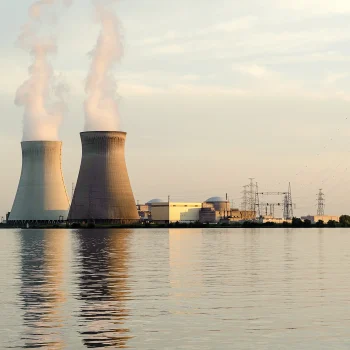
It must be managed technically, conservatively and without illusion. When we look at concrete and steel storage systems beside a nuclear power plant, we are not looking at uncontrolled danger.
We are looking at a carefully designed and licensed system whose purpose is to keep spent fuel stable, shielded, cooled, confined and traceable over time.
There is a certain humility in this kind of engineering.
It does not rely on spectacle.
It does not rely on rapid action.
It does not ask the system to be clever every second.
It asks the system to be stable.
That is the logic of dry storage: safety based on physical principles, conservative margins and long-term responsibility.
References / Sources
- International Atomic Energy Agency (IAEA), guidance and publications on spent fuel storage and spent fuel management.
- U.S. Nuclear Regulatory Commission (NRC), Dry Cask Storage information and regulatory guidance.
- Krško Nuclear Power Plant (NEK), publicly available information on dry spent fuel storage.
- Holtec International, publicly available HI-STORM / MPC system information.
- Publicly available technical documentation and licensing material used for documentation-driven 3D study.
Author’s Note
This article was written as part of my in-depth study of nuclear systems and their visual interpretation through documentation-driven 3D modeling.
It is an original technical text intended to support understanding of dry storage system logic, not to replace regulatory documentation, vendor documentation or site-specific safety analysis.
Any associated 3D model or visualization should be understood as an educational and interpretive study model based on publicly available technical references. It is not an official vendor model, not a manufacturing model and not a representation of any specific licensed installation unless explicitly stated.
Confinement Decay Heat Dry Cask Storage Dry Storage nuclear safety Passive Safety Radiation Shielding Spent Nuclear Fuel Subcriticality Technical Visualization
Last modified: August 21, 2026