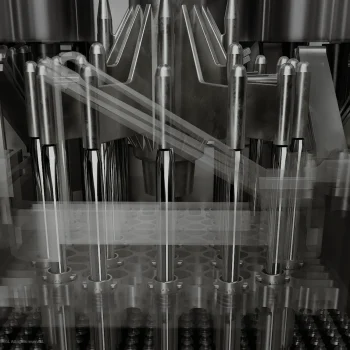


Introduction to Nuclear Fuel Architecture
In PWR nuclear power plants, the fuel assembly is the part of the reactor core that largely determines energy efficiency, neutron economy, and the long-term safety of operation.
Although it may appear to be a standardized industrial product, its internal logic is the result of decades of development, optimization, material studies, and engineering compromises. To understand it properly means to understand why modern light-water reactors are so robust, predictable, and efficient.
The purpose of this article is to present the basic architecture of a PWR fuel assembly and the process of its detailed 3D visualization, combining technical understanding, material science, and visual minimalism.
Geometry and the Functional Logic of the 17×17 Structure
The basis of the fuel assembly is a 17×17 matrix, in which fuel rods are arranged around guide tubes and an instrumentation channel. This geometry is not accidental. It provides the right balance between fuel density, space for coolant flow, and neutron moderation.
Within these square grids are fuel rods: hermetically sealed tubes made of Zircaloy-4 alloy, filled with ceramic uranium dioxide pellets.
These rods are not merely “fuel containers”. They are one of the most important safety barriers, since fission products remain contained inside them. To perform this function for several years, they must withstand high temperatures, intense neutron flux, vibration, and a combination of corrosive and mechanical loads.
Inside the Fuel Rod: Pellets, Plenum, and Spring
The inside of the fuel rod is also carefully designed.
UO₂ pellets have rounded edges and slight concave depressions on both sides, allowing them to better withstand mechanical stresses that develop during operation due to fuel swelling. Their porosity and microstructure influence heat conductivity, which decreases during irradiation. This is one of the key reasons why the precise geometry of the cladding is so critical.
Between the pellets and the cladding there is a narrow gas gap filled with helium, which improves heat transfer. Above the pellets is a plenum with a spring, designed to compensate for the expansion of gases produced by fission.

Guide Tubes and the Topology of Control Rods
Guide tubes run between the fuel rods. Their function is to guide the control rods and provide a stable, repeatable path for absorber insertion during reactor regulation or rapid shutdown.
Although these tubes may appear simple, they are mechanically demanding. Their length exceeds four meters, they are supported by spacer grids, and they connect the top and bottom nozzles.
Patents such as the Westinghouse description of mechanical connections between Zircaloy guide tubes and steel nozzles, for example patent US 3,791,466, show how complex it is to connect materials with entirely different properties under irradiation and in hot water.
Avoiding welded joints between two different metals, because such welding can create brittle intermetallic phases, leads to mechanical solutions that allow thermal expansion while preserving structural integrity.
Spacer Grids: The Hydraulic Cores of Stability

Spacer grids, placed along the length of the fuel assembly, hold the rods in precise positions and shape the hydraulic environment through which the coolant flows.
They are made of Inconel, or of a combination of Inconel and Zircaloy, because they must withstand vibration, thermal-hydraulic turbulence, and high temperatures.
In addition to their structural function, the grids also include springs and dimples, which provide elastic support and ensure stable positioning of the fuel rods.
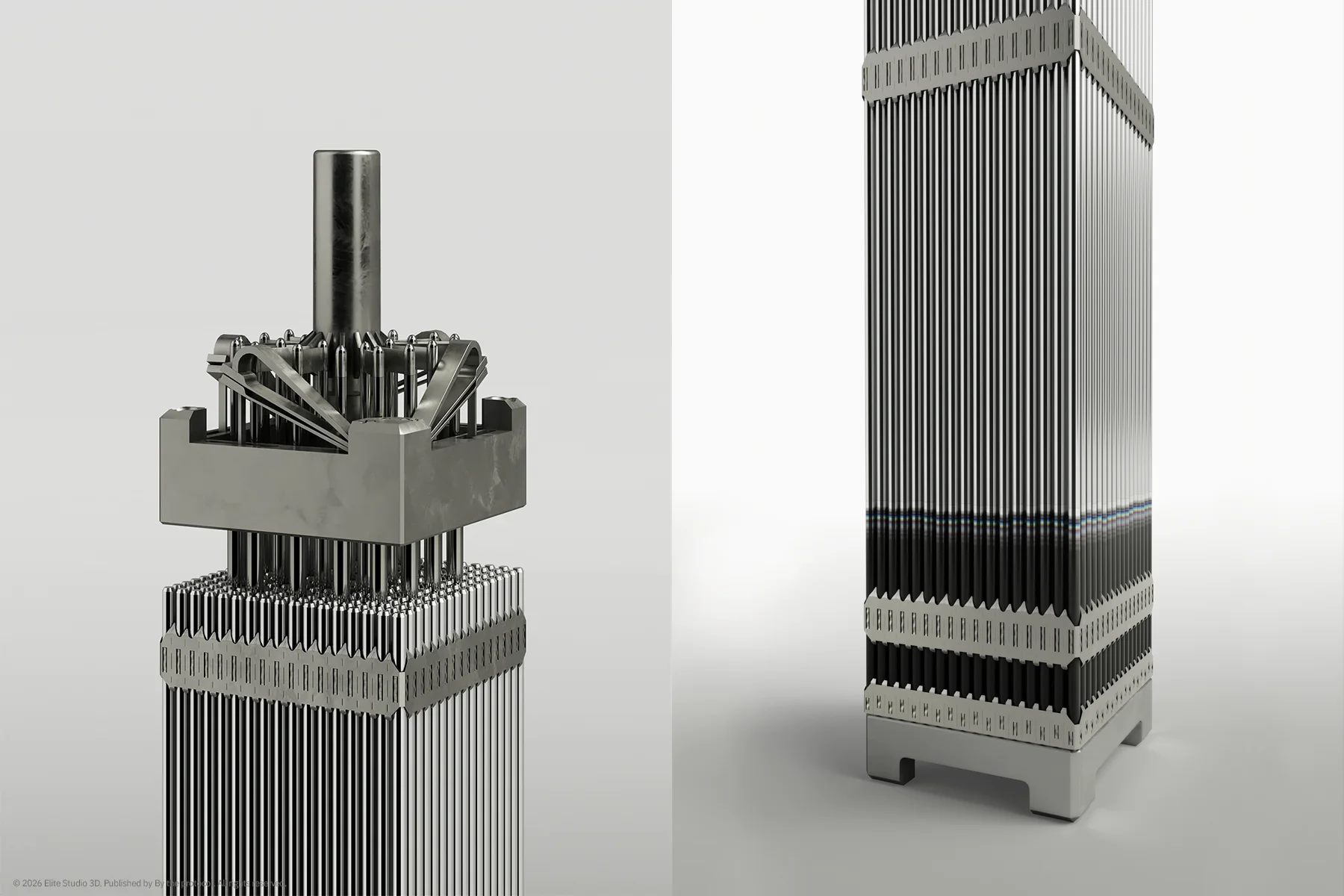
In this visualization, the springs and dimples are modeled in detail, following their generally known structure. These elements are essential for the mechanical stability of the fuel assembly, since they reduce the risk of vibration-induced fretting and maintain the repeatable position of the rods under all operating conditions.
This type of design is standard in PWR fuel and is also supported by publicly available technical reference documentation and patents describing different anti-fretting spring and contact surface designs, such as patent US 7,835,484.
The only part of the grids intentionally not included in this visualization are the mixing vanes. These vanes, whose geometry is commercially sensitive among fuel manufacturers, are omitted from the model out of respect for industrial intellectual property.
Even without them, the grid still presents its primary structural and mechanical logic without entering proprietary design territory.
Top and Bottom Nozzle: Flow Mechanics and Structural Support
The top and bottom nozzles lock the fuel assembly together and connect it with the reactor core.
The top nozzle contains a spring system that prevents the assembly from lifting due to coolant flow, while also providing a path for the control rods.
The bottom nozzle distributes the coolant, transfers mechanical loads during handling, and provides precise anchoring for the guide tubes.
At the lower part of the assembly, characteristic material transitions also appear: steel components, brazed joints, and areas where cladding oxidation is most common due to flow and temperature conditions.
One of the renders presents this visual phenomenon in a realistic and technically coherent way.
3D Modeling as Technical Interpretation
3D modeling of the fuel assembly was not merely a reconstruction. It was a process of understanding.
Because commercial CAD models are not publicly available, the geometry had to be derived from publicly accessible documentation, patent drawings, photographs, and plans that often show only partial information.
This made interpretation necessary. Every piece of geometry had to follow technical logic, even when it was not directly defined.
Special attention was given to material behavior and appearance: the surface quality of Zircaloy, the warmer tones of Inconel, the sharper reflectivity of stainless steel, and the visual representation of oxidation.
The visual style is minimal, clean, and free of unnecessary artistic additions. Its purpose is to emphasize function, not decoration.
Parts such as the top nozzle, spacer grids, and the fuel rod cross-section were among the most difficult to model, because they require an understanding of both mechanical and thermal-hydraulic principles.
At the same time, it was necessary to maintain respect for protected industrial solutions and avoid geometries that belong to proprietary technologies.
Conclusion: Visualization as a Bridge Between Technology and Understanding
A PWR fuel assembly is a deeply interdisciplinary object. It combines physics, metallurgy, thermal hydraulics, neutronics, and mechanical engineering into something that may appear simple at first glance, but is in fact highly sophisticated. A 3D visualization of this system is not merely an aesthetic representation. It is a way of making the invisible visible: of showing an internal structure that, in reality, remains hidden, but is essential for understanding nuclear technology.
This project therefore combines precision, respect for industrial intellectual property, and visual clarity. In the renders, especially the one showing oxidation near the bottom nozzle, the story of materials, aging, and functionality becomes visible. This is not only a representation of fuel. It is a representation of technology that operates for decades and remains one of the most demanding constructions produced by humankind.
The visualizations accompanying this article are original works by Elite Studio 3D. They are intended exclusively for educational and communication purposes. The model is based on publicly available Westinghouse technical documentation and represents a visual interpretation of the basic architecture of a PWR fuel assembly. It is not an official reconstruction and does not represent the exact geometry of any commercial fuel model.
3D visualization Documentation-Driven Reconstruction fuel rods guide tubes nuclear fuel PWR fuel assembly reactor core reactor geometry reactor logic reactor materials spacer grids technical reconstruction uranium dioxide Zircaloy
Last modified: August 21, 2026