
Safety by Design: The Logic Behind Nuclear Systems
Nuclear systems are not designed around optimism. They are designed around credible failure, conservative margins, physical feedback, redundancy, and verified safety functions. Safety is not treated as a promise, but as a documented property of the system.


Why nuclear safety is built on conservative assumptions, failure scenarios, physical feedback, and verified system behavior.
In many technical systems, safety is implicitly linked to normal operation. As long as input conditions remain within expected limits, the system is considered stable, and risks are treated as exceptions. Nuclear systems are designed differently. The fundamental assumption of nuclear engineering is not that everything will go right. It is that deviations are possible, failures must be anticipated, and safety functions must remain credible even when conditions become abnormal. Safety is therefore not built around the best-case scenario. It is built around the worst credible one.
In systems where safety depends too heavily on ideal conditions, good timing, or perfect decisions, the margin between normal operation and failure can become fragile. In nuclear systems, safety must be more than confidence. It must be embedded into the design. At the design level, conservative assumptions are introduced from the beginning:
- material properties are treated with safety margins,
- thermal and neutronic margins are not optimized to the edge,
- operating regimes are constrained by technical and administrative limits,
- analyses consider sequences of failures, not only isolated events,
- safety functions are verified against defined acceptance criteria.
This logic changes the meaning of safety. A nuclear system does not assume that an operator will always recognize the situation immediately and respond perfectly. It assumes that:
- signals can be lost,
- indications can be ambiguous,
- decisions can be delayed,
- actions can be late,
- procedures may need to guide behavior under stress.
For this reason, key safety functions are designed without optimistic assumptions about human behavior. A reactor cannot depend only on “the right decision at the right time.” It must depend on correct design, verified logic, physical feedback, and clearly defined responsibility long before anything happens.
This is where fail-safe thinking becomes essential.
In the event of loss of power, signal, or control, the system must move toward a safer condition rather than require perfect intervention. Reactivity control, heat removal, confinement of radioactive material, and monitoring must remain credible even when parts of the system are unavailable.
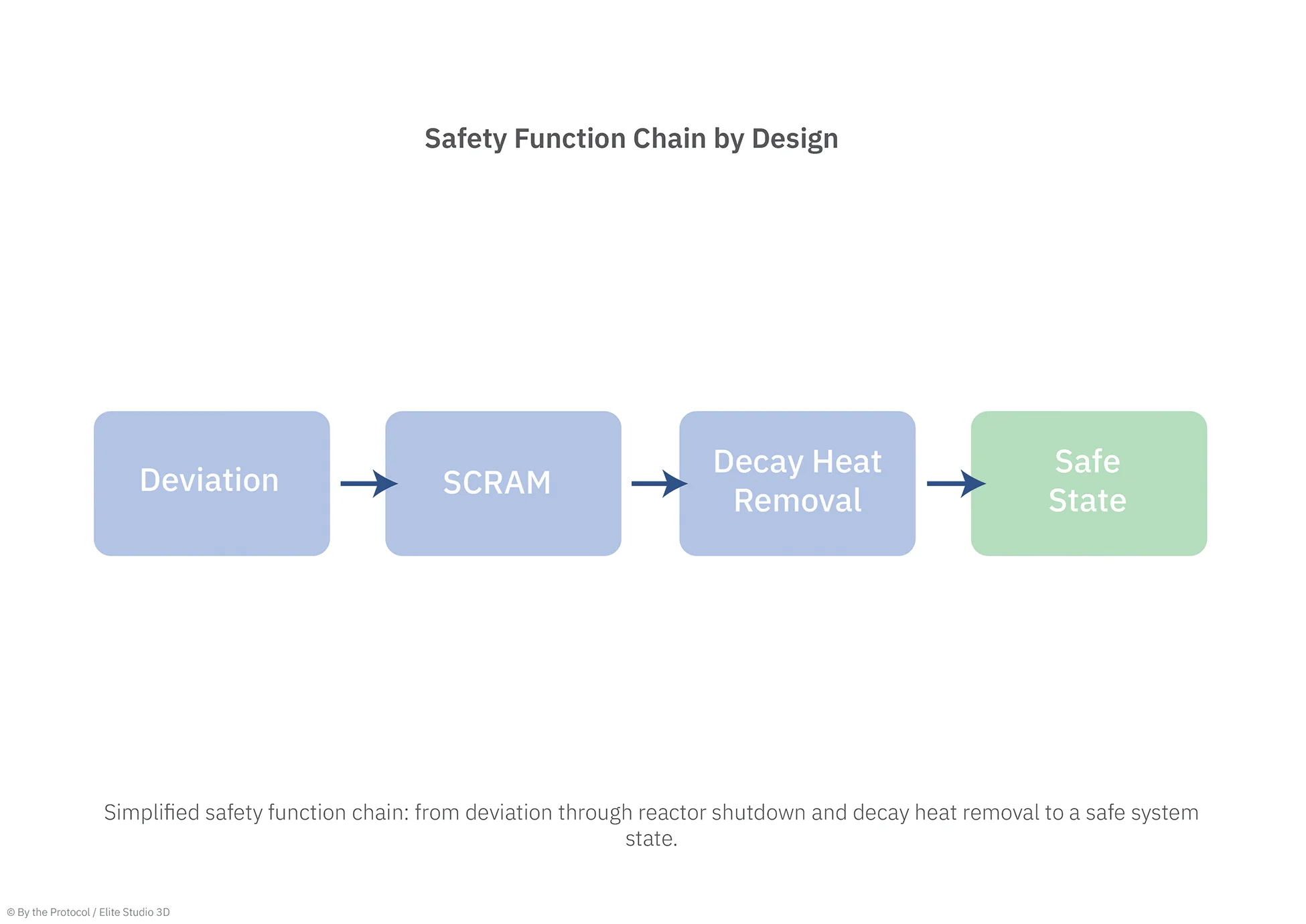
SCRAM is not theatrical. It is not a dramatic last resort. It is an expected system response to deviation: a rapid insertion of negative reactivity intended to stop the chain reaction and place the reactor in a subcritical state.
But even after shutdown, the system is not finished. Decay heat remains. That is why nuclear safety cannot be reduced to one action, one button, or one component. Shutdown must be followed by heat removal. Heat removal must be supported by coolant inventory, flow paths, power supply, instrumentation, and time.
Safety is a chain of functions. Each function has to remain credible under stress.
Redundancy is therefore not simple duplication. It is not just “more of the same.” In nuclear design, redundancy must be supported by functional and physical independence:
- diverse measurement channels,
- independent power supplies,
- alternative operating principles,
- active and passive safety systems,
- spatial separation to reduce common-cause failures,
- barriers that limit the consequences of failure progression.
This is why nuclear systems are designed not only for stable operation, but also for prolonged abnormal conditions:
- loss of offsite power,
- failure of multiple systems,
- degraded instrumentation,
- restricted access,
- limited or delayed human intervention,
- long-duration heat removal requirements.
In such conditions, optimism has no functional value. What matters is whether the system still has a path to safety. That path may depend on engineered systems.
It may depend on gravity, natural circulation, negative feedback coefficients, pressure boundaries, coolant inventory, and the thermal inertia of massive structures. It may depend on procedures, training, and decision-making discipline. But none of these elements can remain abstract. They must be analyzed, documented, simulated, tested, reviewed, and confirmed through regulatory review.
Nuclear safety is therefore not a matter of trust alone. It is a matter of verifiable system behavior. Every assumption must be visible. Every margin must be justified. Every safety function must have a defined purpose. Every failure scenario must be treated as part of the design logic, not as an uncomfortable exception.
That is why nuclear systems do not run on optimism. They run on conservative design, failure assumptions, physical feedback, documented analysis, and clearly defined responsibility. And it is precisely this approach, often misunderstood as excessive caution, that allows nuclear technology to operate reliably for decades.
Not because nothing can go wrong. But because the design begins with the understanding that something might.
By the Protocol Conservative Design Failure Assumptions nuclear safety Nuclear Systems Passive Safety Reactor Physics reactor safety redundancy Safety by Design safety culture SCRAM System Logic technical communication
Last modified: July 8, 2026