

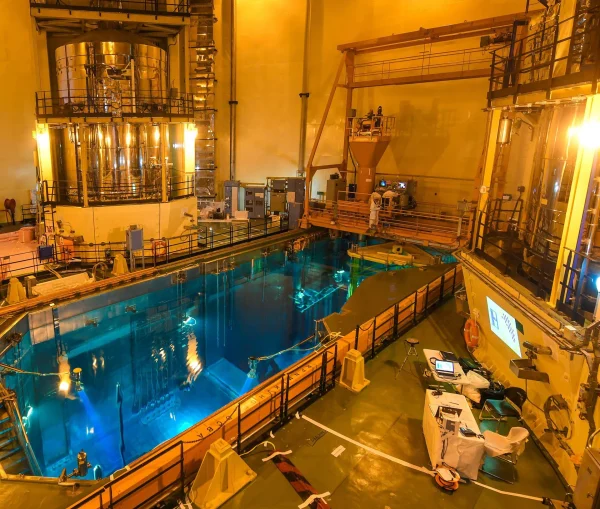
The Bridge Above the Blue

The blue glow may be the spectacle, but the bridge above it shows responsibility. A personal reflection on nuclear work, procedure and the quiet human presence above complex systems.
The blue glow may be the spectacle, but the bridge above it shows responsibility. A personal reflection on nuclear work, procedure and the quiet human presence above complex systems.

After a rapid reactor shutdown, fission power falls sharply, but the need for cooling remains. The protection signal must be followed by verification of the actual response, maintenance of subcriticality and assured heat removal. Reaching a stable state brings together system performance, assessment of measurements and coordinated crew action. Its significance lies in the ability to sustain the required safety functions over the long term.
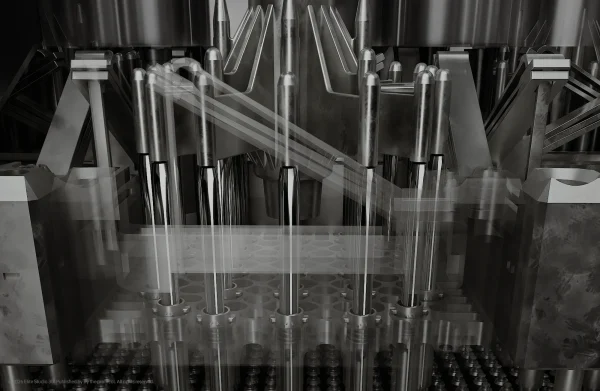
SCRAM is a protective function intended to shut down a reactor rapidly by inserting negative reactivity. It can be initiated automatically or manually. When successfully completed, it brings the reactor to a subcritical state and rapidly reduces fission power. Understanding the event requires knowing why the trip was initiated, how the reactor actually responded, and whether the plant can continue to remove heat.

Non-destructive testing is not only about finding defects. In nuclear maintenance, it is part of a wider verification chain: inspection without unnecessary disturbance, evidence without assumption, and technical judgement supported by qualified people, controlled procedures and traceable records.

Nuclear safety culture is not a slogan, a poster or a formal statement on a wall. It is the way an organization thinks, communicates, questions, learns and responds when safety matters.

Boron and gadolinium do not produce energy in a reactor. They help define the conditions under which energy can be produced safely, predictably, and over time.

A natural-draft cooling tower is easy to recognize from a distance. Understanding it is something else. This article follows the reconstruction of a cooling tower beyond its familiar silhouette, toward the internal logic of water distribution, airflow, evaporation, access, and heat rejection.

Operator error is often used as a simple explanation for failure. In complex technical systems, it should not close the analysis. It should open a deeper question: what made the action possible, likely, or difficult to recover from?

A documentation-driven reconstruction of a NuScale SMR reactor pressure vessel, based on publicly available FSAR documentation and developed from internal volume and system topology toward upper internals, CRA and ICI penetrations, CRDM housing interfaces, feedwater geometry, and containment vessel constraints.

In the NuScale SMR integral PWR configuration, the reactor pressure vessel is not only a pressure boundary around the core. Based on publicly available FSAR documentation, it can be read as a compact system architecture where core geometry, steam generation, pressurizer volume, natural circulation and passive safety functions are closely connected.